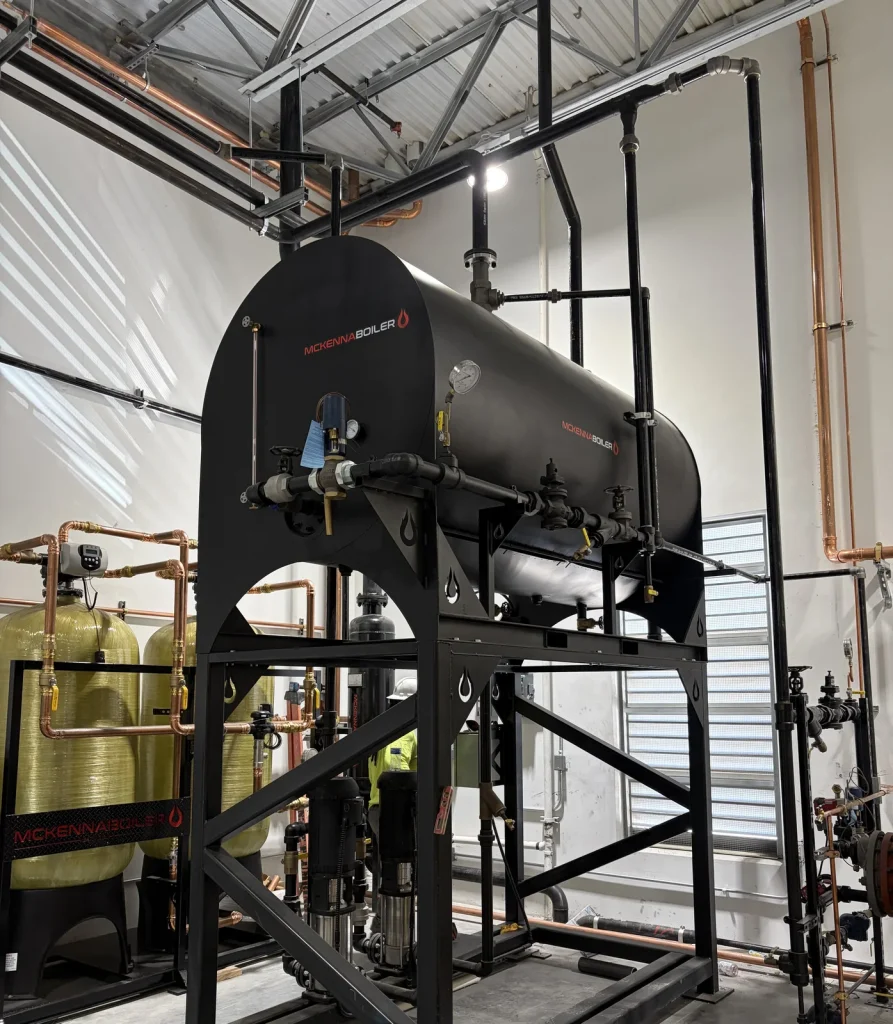

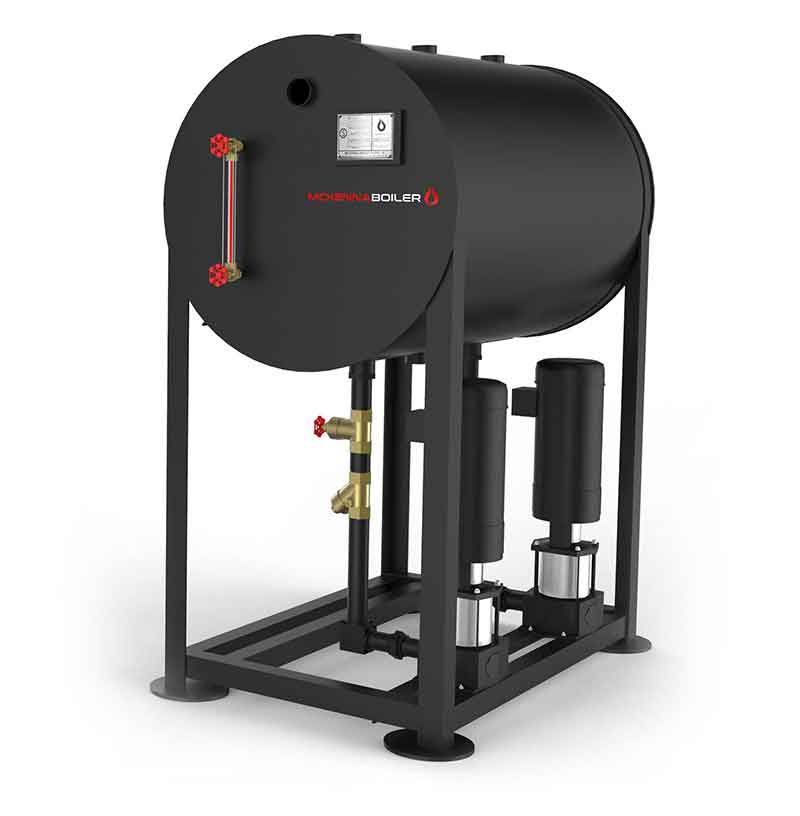
A boiler feedwater system collects returning condensate and makeup water, heats it to drive off dissolved oxygen, and pumps it into the boiler above boiler pressure whenever the level control calls for water. McKenna Boiler Works, Inc. builds feedwater systems in California, standard or custom-sized to the boiler and the room. This post explains what each part of a feedwater system does, how it fails, and what an operator should watch.
What does a feedwater system do?
On most firetube boiler plants, the feedwater system is built around an atmospheric feedwater tank, vented to atmosphere, with these jobs:
- Collect water. Condensate returns from the steam system, and treated makeup water replaces what was lost to blowdown, leaks, and steam used directly in the process.
- Heat it. Dissolved oxygen and carbon dioxide come out of water as it gets hotter, and both corrode steel. Most tanks are heated with a steam sparge or by hot condensate. The water treatment company adds an oxygen scavenger to remove what heating leaves behind.
- Feed the boiler. A feed pump moves water from the tank into the boiler against boiler pressure, under the control of the boiler’s level control.
Plants that need lower oxygen levels, often larger or higher-pressure plants, use a pressurized deaerator in place of an atmospheric tank. A deaerator heats the water with steam to saturation under a few psi of pressure and strips out far more oxygen than an atmospheric tank can.
Why does tank temperature matter to the feed pump?
A centrifugal feed pump needs a minimum margin of pressure above the water’s vapor pressure at its inlet, the net positive suction head required (NPSHr) that the pump manufacturer lists, and the installation must supply more than that (NPSH available). Hot water is close to its boiling point, so if the pressure at the pump inlet falls too low, the water flashes to vapor inside the pump. The vapor bubbles collapse against the impeller, which is cavitation: a gravel-like noise, falling discharge pressure, and eroded impellers.
The fix is in the design. The tank sits high enough above the pump to give the required NPSH at the tank’s operating temperature, and the suction line is short, full size, and has a strainer that stays clean. In a vented tank near 212°F, the water’s vapor pressure is close to atmospheric pressure, so almost all of the available NPSH comes from the height of the water above the pump, minus suction line losses. When a plant raises tank temperature to remove more oxygen, it should confirm the pump still has enough NPSH at the new temperature. Tank volume matters too: it should hold enough water to cover the boiler’s demand while condensate is slow to return. The feedwater tank sizing calculator gives a starting size.
On the discharge side, ASME Section I (PG-61) requires each source of feedwater to be able to supply water to the boiler at a pressure 3 percent higher than the highest setting of any safety (pressure relief) valve on the boiler. In practice the pump is sized for that pressure plus the losses through the piping, check valves, and any feedwater valve, at the boiler’s full evaporation rate.
How is the water level controlled?
- On/off control. A float or probe control starts the feed pump at a low level and stops it at a high level. It is simple and common on smaller firetube boilers, but each slug of cooler water drops steam pressure slightly.
- Modulating control. The pump runs continuously and a feedwater valve opens and closes to hold the level steady. It holds steadier pressure and is common on larger boilers and those with economizers.
Either way, the low water cutoff is a separate safety device. It shuts the burner off if the level falls too far, whatever the feed control is doing.
What treatment does feedwater need?
The site’s water treatment company sets the chemical program, tests the water, and should be on site during inspections to check and monitor the water side. The equipment side of that program usually includes:
- Softener to remove calcium and magnesium hardness, which forms scale on heating surfaces.
- Reverse osmosis where makeup water is high in dissolved solids. Lower solids means less blowdown. RO does not remove dissolved gases.
- Chemical feed for oxygen scavenger, internal treatment, and condensate treatment, dosed as the water treatment company directs.
- Makeup water meter. Rising makeup flow is the first sign of lost condensate or a leak.
Why return as much condensate as possible?
Condensate is hot, already treated, and almost free of dissolved solids. Every pound returned is a pound of makeup water that does not need to be bought, softened, treated, and heated from ground temperature. The U.S. Department of Energy covers this in its steam tip sheet on returning condensate to the boiler. Condensate can pick up contamination from a leaking process heat exchanger, so plants with that risk monitor condensate conductivity and dump bad condensate to drain. Failed steam traps reduce return and waste steam; a steam trap audit finds them.
A feedwater economizer in the stack heats feedwater with flue gas before it enters the boiler. The Department of Energy rule of thumb is about 1% efficiency for every 40°F reduction in stack temperature.
| Component | What goes wrong | What you see |
|---|---|---|
| Feedwater tank | Temperature too low, vent blocked | Oxygen pitting in tubes over time; pressure in a tank that should be atmospheric |
| Feed pump | Cavitation, worn impeller, clogged strainer | Noise, slow level recovery, low water alarms |
| Level control | Fouled probe or float chamber | Erratic level, pump short cycling, high water and carryover |
| Softener | Exhausted resin, failed regeneration | Hardness in feedwater, scale at the next inspection |
| Condensate return | Failed traps, leaks, contamination | Rising makeup flow, cooler tank, high conductivity |
What to check
Follow the equipment manufacturer’s instructions, lockout/tagout, and your site’s procedures. Never open a pressurized tank, pump, or line.
- Log feedwater tank temperature and level every shift.
- Listen to the feed pumps for cavitation, and check discharge pressure against its normal reading.
- Watch how quickly the boiler level recovers after the pump starts.
- Read the makeup water meter daily and compare with normal.
- Run the softener hardness test the water treatment company specifies.
- Clean pump suction strainers on schedule, with the pump isolated, locked out, cooled, and drained per site procedure.
- Test the low water cutoff as the boiler manufacturer directs. If the burner does not shut off, shut it off manually and call for service.
- Confirm the tank vent is open and not steaming excessively.
Common questions
What temperature should a feedwater tank run at?
Hot enough to drive off most of the dissolved oxygen, within the limit the feed pump’s NPSH allows. The boiler or feedwater system manufacturer and the water treatment company should set the target for your plant.
What is the difference between a feedwater tank and a deaerator?
A feedwater tank is vented to atmosphere and removes part of the dissolved oxygen by heating, with chemicals removing the rest. A deaerator runs slightly above atmospheric pressure at saturation temperature and strips most of the oxygen mechanically. Deaerators are used where lower oxygen levels are needed.
Why is my feed pump noisy?
A gravel-like noise usually means cavitation: the water is flashing at the pump inlet because the tank is too hot for the available NPSH, the suction strainer is clogged, or the tank level is low. Have it checked before the impeller is damaged.
Who decides how much chemical goes into the feedwater?
The site’s water treatment company. They set the program from water tests and adjust it as conditions change. Plant staff run the routine tests and report results.
How much condensate should come back?
As much as the process allows. Steam used directly in the product or injected into the process is lost; condensate from heat exchangers, coils, and jackets can usually come back. A falling feedwater tank temperature or rising makeup flow means return has dropped.
McKenna Boiler Works, Inc. builds feedwater systems in California, sized to the boiler and the room, and services and repairs other brands. For scheduled checks on pumps, controls, and tanks, see preventative maintenance or call (323) 987-1816.