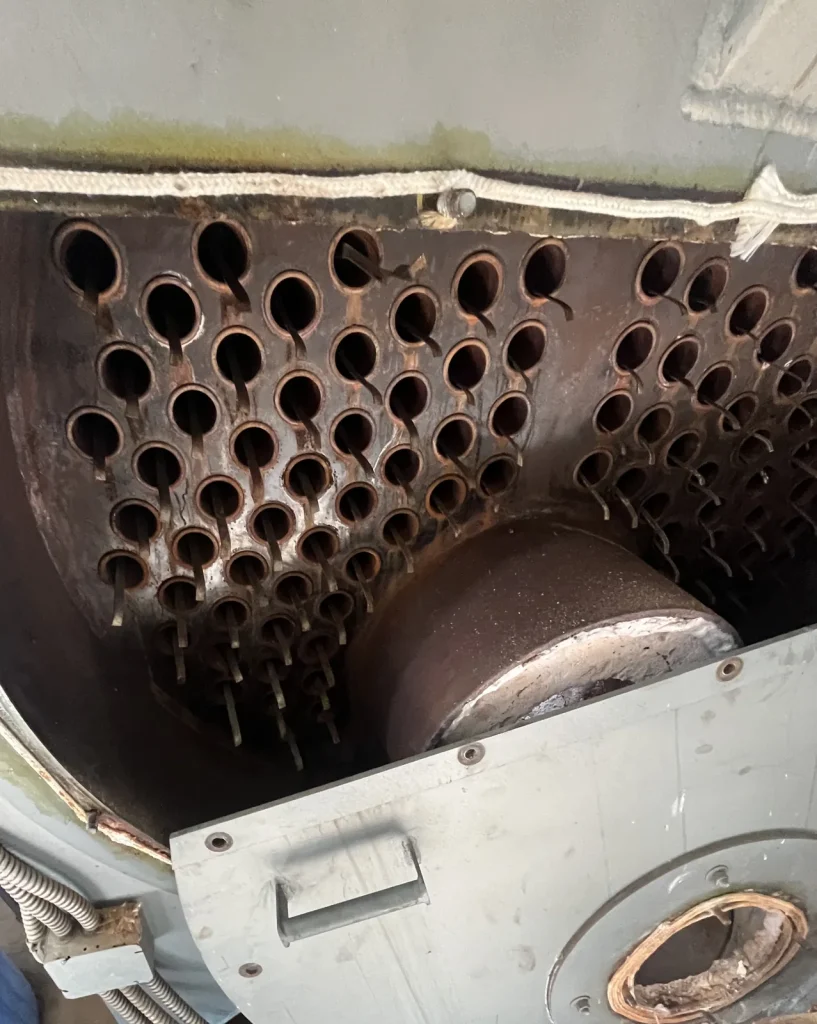

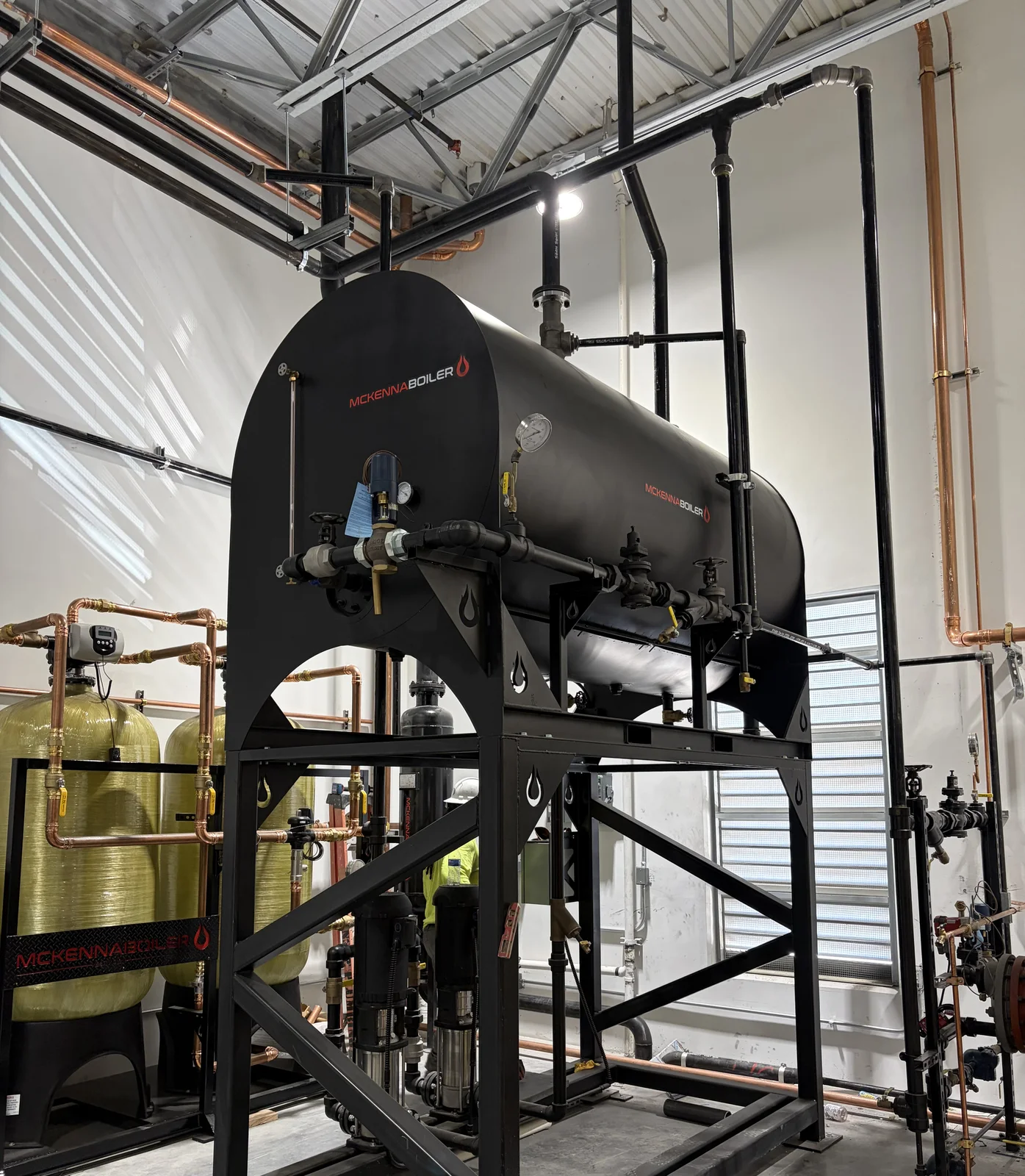
Feedwater and boiler water chemistry decide how long the pressure parts of an industrial boiler last. Hardness forms scale that drives tube and furnace metal temperatures up, dissolved oxygen pits steel, carbon dioxide corrodes condensate lines, and concentrated solids cause carryover and deposits. McKenna Boiler Works, Inc. is not a water treatment company: your water treatment company sets the program, and McKenna inspects, maintains, and repairs the boiler that program protects.

What does scale do to a firetube boiler?
Calcium and magnesium hardness, and silica, come in with the makeup water. Calcium carbonate and calcium sulfate become less soluble as water gets hotter, so they come out of solution on the hottest surfaces first: the furnace and the first-pass tubes. As water boils off as steam, the minerals left behind keep concentrating.
Scale conducts heat poorly. The burner’s heat still has to pass through the steel and then the scale to reach the water, so the steel runs hotter to push the same heat through. In the furnace, where heat flux is highest, that can overheat the metal enough to bulge the furnace or crack tube ends. Stack temperature also rises, because less heat is absorbed, and fuel use goes up. Loose sludge settles at the bottom of the shell, where bottom blowdown removes it.
How do oxygen and carbon dioxide cause corrosion?
Dissolved oxygen attacks steel at local spots and forms pits. Pitting is the dangerous kind of corrosion because it goes deep in a small area, and a pit can go through a tube wall while the rest of the tube looks fine. It is worst where oxygenated water first meets hot steel: the feedwater line, the feed connection, and tubes near it. Oxygen comes out of water as it heats, so the first defense is mechanical. A deaerator heats feedwater to saturation and vents the released gases, and a hot feedwater tank removes part of the oxygen. An oxygen scavenger, usually sodium sulfite, removes what is left. Operators test the sulfite residual to confirm there is enough.
Carbon dioxide comes from bicarbonate and carbonate alkalinity in the makeup water. In the boiler these break down and release CO2, which leaves with the steam and dissolves in the condensate as carbonic acid. That acid thins condensate piping and eats threads, usually along the bottom of the pipe. The controls are reducing alkalinity in the makeup water and neutralizing amines chosen by the water treatment company.
Caustic gouging is a third mechanism. Where deposits are porous or steam blankets a surface, boiler water concentrates under the deposit and caustic attacks the steel underneath. Keeping deposits off the heating surface and alkalinity in range prevents it. Idle boilers corrode too, so lay up any boiler that sits as the boiler manufacturer’s manual specifies, with your water treatment company setting the chemistry.
What does a treatment program include?
| Control | What it does | Who handles it |
|---|---|---|
| Water softener | Removes hardness from makeup water by ion exchange | Operators regenerate and test; the program sets the hardness limit |
| Deaerator or hot feedwater tank | Drives out dissolved oxygen and CO2 by heating | Operators hold the temperature and keep vents working |
| Oxygen scavenger | Removes remaining oxygen chemically | Water treatment company sets the residual; operators test |
| Internal treatment and dispersants | Keeps hardness leakage and iron in suspension so blowdown can remove them | Water treatment company |
| Surface (continuous) blowdown | Holds dissolved solids and conductivity in range | Operators or automatic controls, to the program’s limits |
| Bottom blowdown | Removes sludge from the bottom of the boiler | Operators, on the program’s schedule |
| Condensate treatment | Neutralizes carbonic acid in return lines | Water treatment company |
Blowdown is a balance. The boiler manufacturer’s manual gives the blowdown limits for your boiler, and your water treatment company sets the rate from your water analysis. Too little blowdown lets solids build up and causes foaming and carryover. Too much wastes hot, treated water and fuel. Returning more condensate lowers the solids coming in, so less blowdown is needed. Blowdown is hot and under pressure, so it goes to a blowdown tank or separator to cool before the drain, as local codes require.
For guidance on limits by operating pressure, many programs refer to the ASME consensus document on operating practices for feedwater and boiler water chemistry in industrial and institutional boilers, first published as CRTD-34. It is guidance. Start with the water limits in your boiler manufacturer’s manual, and work with your water treatment company to set the limits for your boiler.
Who is responsible for what?
- Your water treatment company sets the program around the boiler manufacturer’s guidelines, chooses the chemicals, sets test limits and frequencies, reviews the logs, and should be on site during inspections to check and monitor the water side while the boiler is open.
- Your operators run the daily tests, log them, blow down on schedule, regenerate the softener, hold feedwater temperature, and report readings that are out of range.
- The boiler service company opens and cleans the boiler, inspects the fire side and water side, and repairs damage. Welded repairs to pressure-retaining parts are made under the National Board Inspection Code (NBIC) Part 3 by an organization holding a National Board R certificate, and accepted by an Authorized Inspector. In most cases, replacing rolled and beaded tubes is not an R stamp repair; check with your Authorized Inspector. McKenna holds National Board R certificate No. 11037 and makes code repairs on boilers and pressure vessels from any manufacturer.
Under Cal/OSHA rules, power boilers are inspected internally and externally each year, by a Cal/OSHA safety engineer or a certified inspector, before the permit to operate is renewed. When the Division considers a longer interval between internal inspections, water treatment records are part of what it reviews.
What to check: an operator’s water-side routine
- Test softened water hardness, boiler water conductivity, and sulfite residual each day the boiler runs, or as the program says, and log every result.
- Hold the feedwater tank at the temperature the program calls for.
- Blow down on the schedule your water treatment company sets, and never less often than the boiler manufacturer’s manual calls for. Open bottom blowdown valves slowly, in the order the manufacturer specifies, watch the gauge glass, and never leave an open blowdown valve unattended. Follow your site’s procedures.
- Read the makeup water meter daily. A rise means condensate is being lost or there is a leak.
- Before an inspection, shut the boiler down and let it cool and lose all pressure before it is drained, following the manufacturer’s instructions. Apply lockout/tagout to fuel, electrical, and water, isolate the steam, feedwater, and blowdown lines, and follow confined space procedures for any entry. Ask your water treatment company to be on site.
- Review the inspection findings with your water treatment company. Scale, pitting, or deposits mean the program needs adjusting.
Common questions
How often should boiler water be tested?
Your water treatment program sets the schedule. For most steam boilers in service, operators test softener hardness, conductivity, and scavenger residual daily, and the water treatment company runs fuller tests on its visits.
Is softened water enough?
No. A softener removes hardness only. Oxygen, carbon dioxide, alkalinity, and silica still have to be handled by deaeration, chemicals, and blowdown.
Do hot water boilers need treatment?
Yes. A closed hot water loop uses little makeup, but it still needs a corrosion inhibitor, and rising makeup in a closed loop points to a leak that brings in fresh oxygen and hardness.
Does McKenna provide water treatment?
No. McKenna Boiler Works, Inc. is not a water treatment company. Your water treatment company sets the chemical program and should be on site during inspections, and McKenna inspects, maintains, and repairs the boiler.
What happens if scale is found during an inspection?
The inspector may require cleaning before the boiler returns to service, and damaged tubes or furnace sections may need repair, with welded repairs made under NBIC Part 3. Your water treatment company should find the cause and adjust the program so it does not return.
To schedule an annual inspection with the boiler opened for the water side, see boiler inspections and testing or call (323) 987-1816.