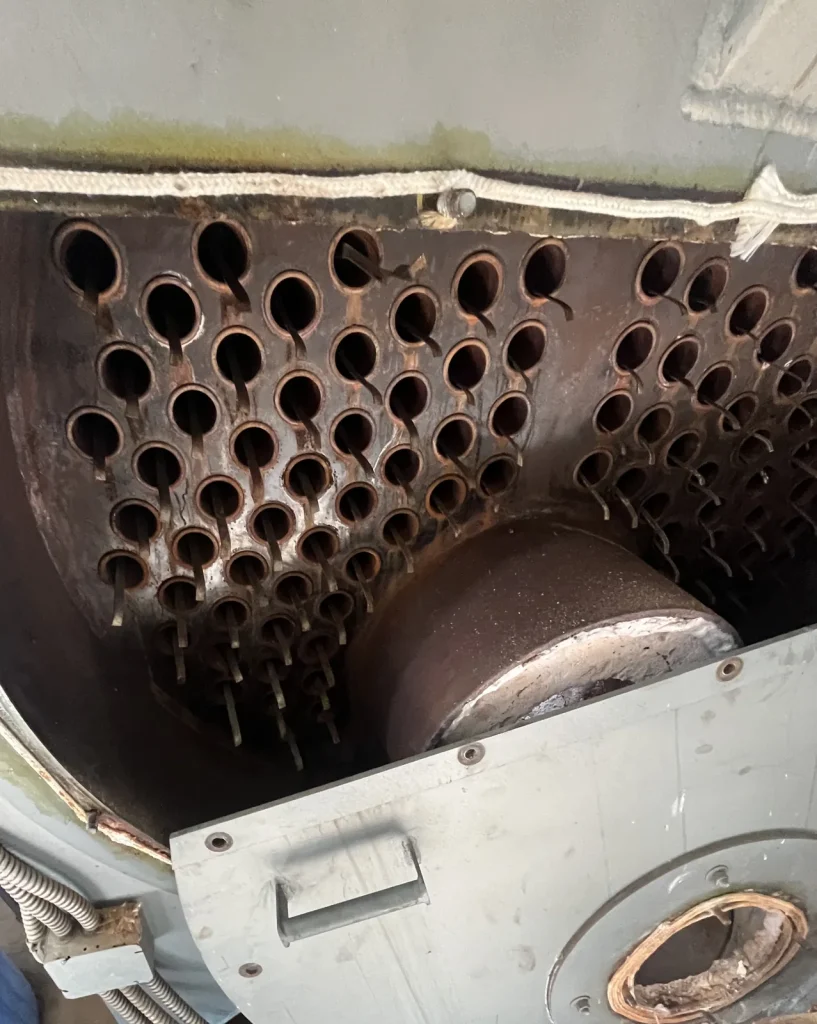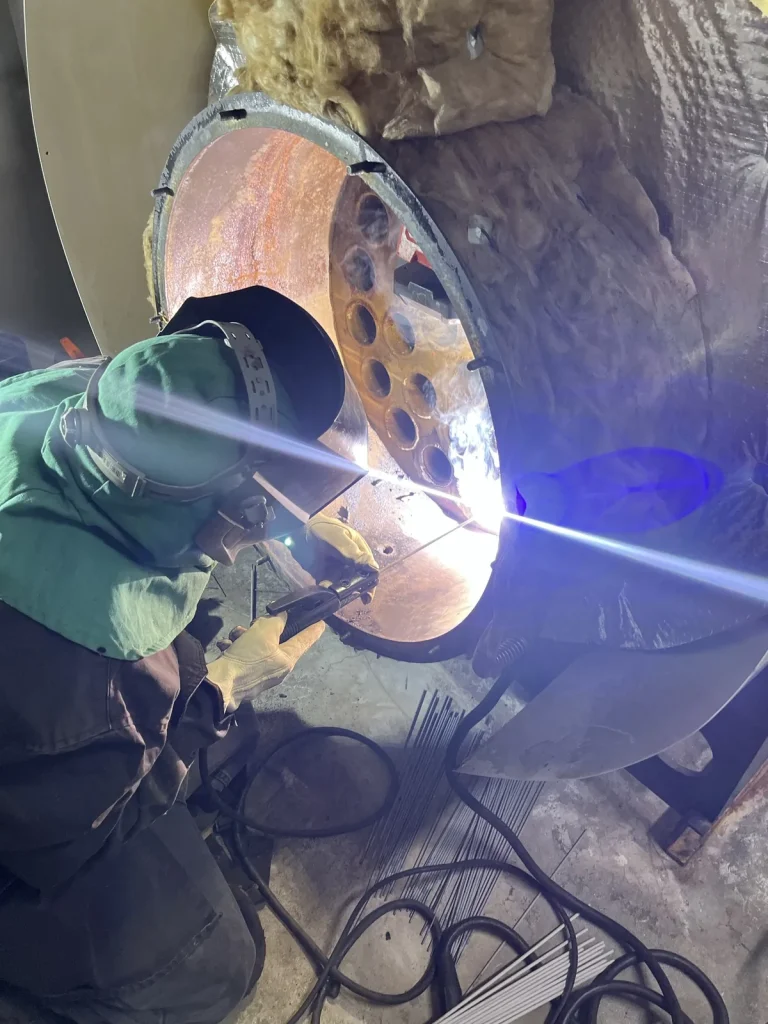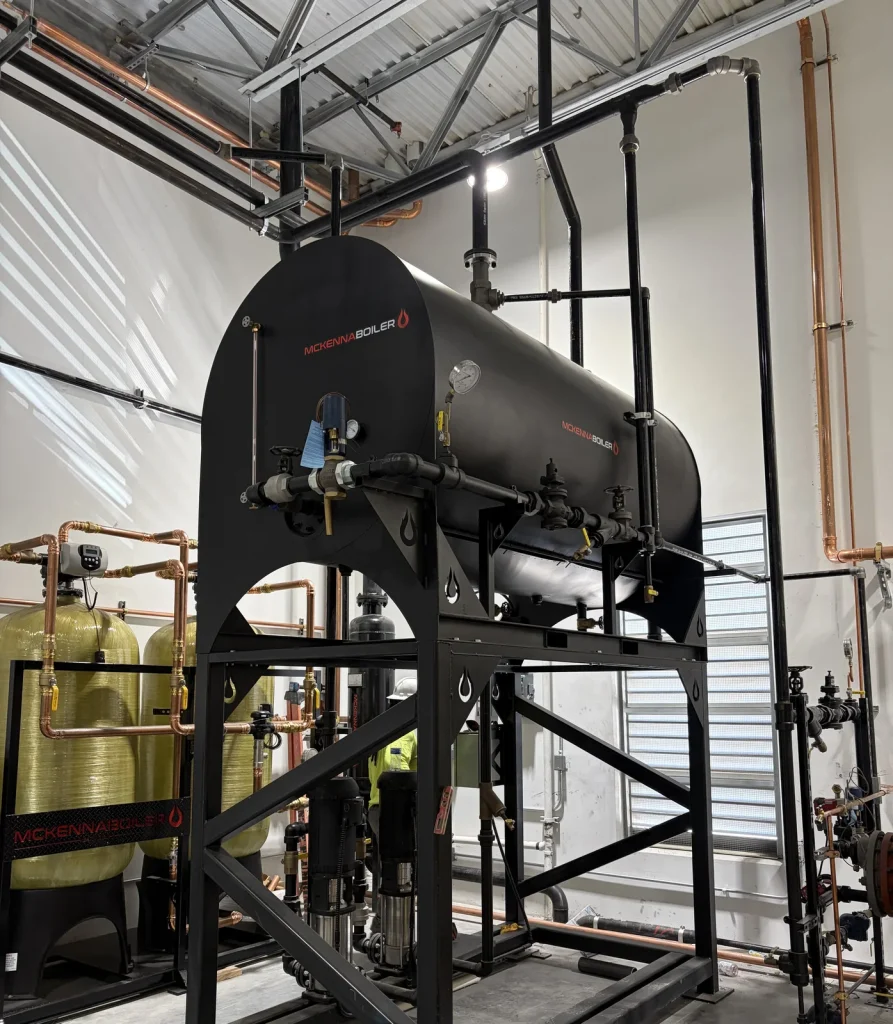


Before a new boiler installation, find out whether the old boiler actually needs replacing. The answer depends on the condition of the pressure parts, whether a retube or a burner and controls upgrade would fix the real problem, what your air district’s emissions limit requires, and what the plant needs now. McKenna Boiler Works, Inc. builds firetube, firebox, and vertical boilers in California and makes code repairs on boilers and pressure vessels from any manufacturer, so it looks at all three paths: repair, retube, or replace.
1. What condition are the pressure parts in?
Age alone is a weak reason to replace a boiler. A firetube boiler with good water treatment and steady operation can run for decades. What decides it is the condition of the parts that hold pressure:
- Tubes. Leaks at the rolled tube ends, thinning from corrosion, or pitting from oxygen.
- Tubesheets. Cracks in the ligaments between tube holes, often from thermal stress or repeated re-rolling.
- Furnace. Bulging or distortion from overheating, which usually traces back to scale on the waterside.
- Shell and stays. Wall thinning, cracked or broken staybolts in a firebox boiler, and corrosion at the waterline.
An internal inspection tells you what is left, and ultrasonic thickness readings, which McKenna can provide by proposal, add measured wall thickness. Welded repairs and alterations to pressure parts, including seal-welded tubes and tubesheet repairs, are done under NBIC Part 3 by a National Board R certificate holder, with the work accepted by an Authorized Inspector. In most cases, replacing rolled and beaded tubes is not an R stamp repair; check with your Authorized Inspector. McKenna holds National Board R certificate No. 11037. A condition inspection before you decide gives you facts to compare.
2. Would a retube or an upgrade solve the real problem?
Most decisions to replace start with a complaint: leaks, lockouts, high fuel use, or a failed source test. Match the fix to the complaint.
| Problem | Often the fix | When replacement makes more sense |
|---|---|---|
| Tube leaks, tubes thin, shell and tubesheets sound | Retube | Tubesheets cracked or the shell is thin |
| Local damage to a pressure part | National Board R repair | Damage is widespread or repeated |
| High excess air, poor turndown, drifting combustion | Burner and controls upgrade with parallel positioning and O2 trim | Furnace too small for a modern burner |
| Cannot meet the air district NOx limit | Ultra-low NOx burner retrofit | Furnace size or geometry will not fit the burner’s flame |
| Load has changed a lot | Controls or an added boiler | Boiler is far oversized or undersized for the new load |
To judge efficiency, compare fuel use per unit of production, or stack temperature and O2 at the same firing rate, over time. Month-to-month utility bills move with weather, production, and gas price, so they are a poor measure of the boiler.
3. What does your air district require?
Emissions limits often decide the question. In the South Coast AQMD, Rule 1146 covers boilers of 5 MMBtu/hr and larger, Rule 1146.1 covers units over 2 and under 5 MMBtu/hr, and Rule 1146.2 covers units of 2 MMBtu/hr and smaller. The San Joaquin Valley APCD has Rules 4306 and 4320 for larger units, and the Bay Area AQMD has Regulation 9, Rule 7. Each sets NOx limits that an older burner may not meet.
An ultra-low NOx retrofit can bring an existing boiler into compliance, but the burner has to fit the furnace: flame length and diameter must suit the furnace dimensions, and the new burner usually needs parallel positioning controls to hold the tight fuel-air ratio. If the furnace is too small, a new boiler matched to the burner and the limit may be the cleaner answer.
4. What does the plant need now and in ten years?
- Load. Has production grown or shrunk? A boiler sized for a load that left years ago short-cycles and wears out faster. Measure today’s peak and minimum before sizing a replacement.
- Turndown. Wide load swings call for a burner that fires low without cycling.
- Footprint and access. Can a new boiler get into the room, or does a wall come out? McKenna builds standard models or custom-designs a boiler to fit a specific room or footprint.
- Downtime. How long can the plant run without the boiler? A rental boiler can carry the load during a retube or replacement.
What to gather before deciding
- The last several inspection reports and any Cal/OSHA inspection findings.
- Repair invoices and a log of unplanned shutdowns for the past few years.
- Combustion reports and any air district source test results.
- Water treatment logs from your water treatment company.
- A condition inspection, with tube and shell thickness readings by proposal if needed.
- Prices for each path: repair, retube, burner upgrade, and replacement, including rental and downtime.
Common questions
How long should an industrial boiler last?
A well-maintained industrial boiler can run for decades. Condition matters more than age: water treatment, steady operation, and repairs made early decide how long the pressure parts last. An inspection tells you where yours stands.
When is a retube worth it?
A retube makes sense when the tubes are leaking or thin but the shell, tubesheets, and furnace are sound. It costs less than a new boiler and keeps the existing foundation, piping, and stack. If the tubesheets are cracked, replacement is often the better path.
Can an older boiler meet ultra-low NOx limits with a new burner?
Often, if the furnace dimensions suit the new burner’s flame and the controls are upgraded. McKenna checks the furnace and the air district limit before recommending a retrofit. Some older boilers have furnaces too small for the burner the limit requires.
Who can repair the pressure parts on a boiler?
Welded repairs and alterations to pressure parts, such as seal-welded tubes and tubesheet repairs, are done under NBIC Part 3 by a National Board R certificate holder, and an Authorized Inspector accepts the work. In most cases, replacing rolled and beaded tubes is not an R stamp repair; check with your Authorized Inspector. McKenna Boiler Works, Inc. holds National Board R certificate No. 11037.
What does McKenna need to quote a replacement?
The load in lb/hr or Btu/hr, operating pressure, fuel, the air district, room drawings or photos with access routes, and the existing boiler’s nameplate. That is enough to compare a retube, a retrofit, and a new boiler.
McKenna builds turnkey boiler systems in California and services and repairs other brands. To compare repair, retube, and replacement for your plant, see boiler replacement or call (323) 987-1816.