

Thomas Newcomen’s engine, first run successfully in 1712 at a coal mine near Dudley Castle in England, used steam at barely above atmospheric pressure, and the work was done by the vacuum left when that steam condensed. It pumped water out of mines for most of the 1700s and is the first steam engine to see wide industrial use. McKenna Boiler Works, Inc. has built boilers since 1921, and the physics Newcomen put to work, steam condensing in a closed space, still shapes how steam systems are designed and operated today.

What problem was Newcomen solving?
By the late 1600s, English coal and tin mines were going deeper, and deeper mines flooded. Pumps driven by horses or water wheels could only lift so much water, and they were costly to run. In 1698 Thomas Savery patented a pump he called the Miner’s Friend, which used steam pressure to push water up a pipe and the vacuum from condensing steam to draw it in. It worked over short lifts, but it needed higher-pressure steam in vessels that could burst, and it could not lift water far enough for a deep mine.
Thomas Newcomen, an ironmonger from Dartmouth, and his partner John Calley took a different approach: a piston in a cylinder, connected to a rocking beam that worked a pump at the bottom of the shaft. Because Savery’s patent was written broadly enough to cover raising water by fire, Newcomen’s engines were built under it, and Parliament extended that patent to 1733.
How did the atmospheric engine work?
The engine’s cycle used two forces: the weight of the pump gear and the pressure of the atmosphere.
- A boiler under the cylinder, a large “haystack” shape with early versions in copper topped with lead, made steam at only a pound or two per square inch.
- The weight of the pump gear at the far end of the beam pulled the beam down on that side, raising the piston. Low-pressure steam filled the cylinder below it as it rose.
- A spray of cold water was injected into the cylinder. The steam condensed almost instantly, shrinking to a tiny fraction of its volume and leaving a partial vacuum.
- Atmospheric pressure on top of the open piston, close to 14.7 psi at sea level, pushed it down into the vacuum. That was the power stroke, and it lifted the pump rods and the water.
- Steam was let in again, the pump weight raised the piston, and the cycle repeated, around 12 times a minute.
The steam in a Newcomen engine never pushed the piston. Its job was to fill the cylinder and then disappear. The engine’s power came from the difference between atmospheric pressure and the vacuum, which is why it is called an atmospheric engine.
Why was it inefficient, and what did Watt change?
Each stroke cooled the whole cylinder with injection water, and the next charge of steam had to reheat that iron before it could fill the space. Much of the steam, and the coal burned to make it, went into warming the cylinder over and over. That was acceptable at a coal mine, where fuel was cheap at the pit head, but costly anywhere coal had to be hauled in.
James Watt’s fix was to condense the steam in a separate vessel, kept cold, while the cylinder stayed hot. He built a prototype and patented the separate condenser in 1769, and his engines went into production in the 1770s. Later engines used steam at higher pressure to push the piston directly, and boilers had to be built stronger to match. Boiler explosions as pressures rose eventually led to construction codes, including the first edition of the ASME Boiler Code, published in 1915.
What does Newcomen’s engine teach about steam systems today?
The force that drove Newcomen’s piston is present in every steam system: when steam condenses in a closed space, its volume collapses and pulls a vacuum. In a modern plant that shows up in a few ways:
- Vacuum in heat exchangers. When a temperature control valve throttles steam to a heat exchanger, the steam inside can condense to below atmospheric pressure. Condensate then cannot drain through the trap, the exchanger floods, and water hammer follows. Vacuum breakers and properly selected traps prevent it.
- Collapsed tanks and vessels. A tank steamed out for cleaning and then sealed can be crushed by atmospheric pressure as the steam cools, unless it is vented or designed for vacuum. Any vessel that may see steam and then cool needs vacuum protection or a vacuum rating.
- Water hammer. Steam meeting a slug of cold condensate in a pipe can condense suddenly; the collapse slams water into fittings hard enough to crack them. Proper drainage, trapping, and slow warm-up prevent it.
- Latent heat. The same condensation that gave Newcomen his vacuum is why steam heats so well: each pound gives up about 970 Btu as it condenses at atmospheric pressure, at a temperature set by its pressure.
What to check in your own steam system
- Confirm that heat exchangers on modulating steam control have vacuum breakers and traps sized for low differential pressure.
- Before steaming out any tank or vessel, open a vent and keep it open until the vessel has cooled, per your site’s procedures.
- Warm up steam lines slowly with drains open, as your procedures and the equipment manufacturer specify, to clear condensate before full steam is admitted.
- Have steam traps tested on a schedule. A steam trap audit finds failed traps that cause flooding and water hammer.
- Follow lockout/tagout before working on any steam line or vessel, and never assume a cooled line is at atmospheric pressure; it may be under vacuum or still pressurized.
Common questions
When did Thomas Newcomen build his engine?
The first successful Newcomen engine ran in 1712 at a coal mine near Dudley Castle in the English Midlands. Newcomen worked with his partner John Calley. Engines of the same design were built for mines in Britain and Europe for decades after.
Did steam push the piston in a Newcomen engine?
No. The weight of the pump gear raised the piston while low-pressure steam filled the cylinder. Cold water condensed the steam, and atmospheric pressure pushed the piston down into the vacuum.
How was Newcomen’s engine different from Savery’s?
Savery’s pump had no piston; it used steam pressure and vacuum directly on the water, which limited how high it could lift and required stronger vessels. Newcomen’s engine used a piston and beam to drive a conventional pump, so it could drain deep mines with steam near atmospheric pressure.
What did James Watt improve?
Watt added a separate condenser so the cylinder stayed hot and the steam did not have to reheat it every stroke. That cut fuel use sharply. He patented the idea in 1769.
How does this relate to modern boilers?
Modern boilers make steam at controlled pressures under ASME construction codes, but steam behaves the same way it did in 1712. Condensation releases latent heat and collapses volume, which is why steam heats well and why steam systems need vacuum protection, traps, and careful warm-up.
Steam systems today
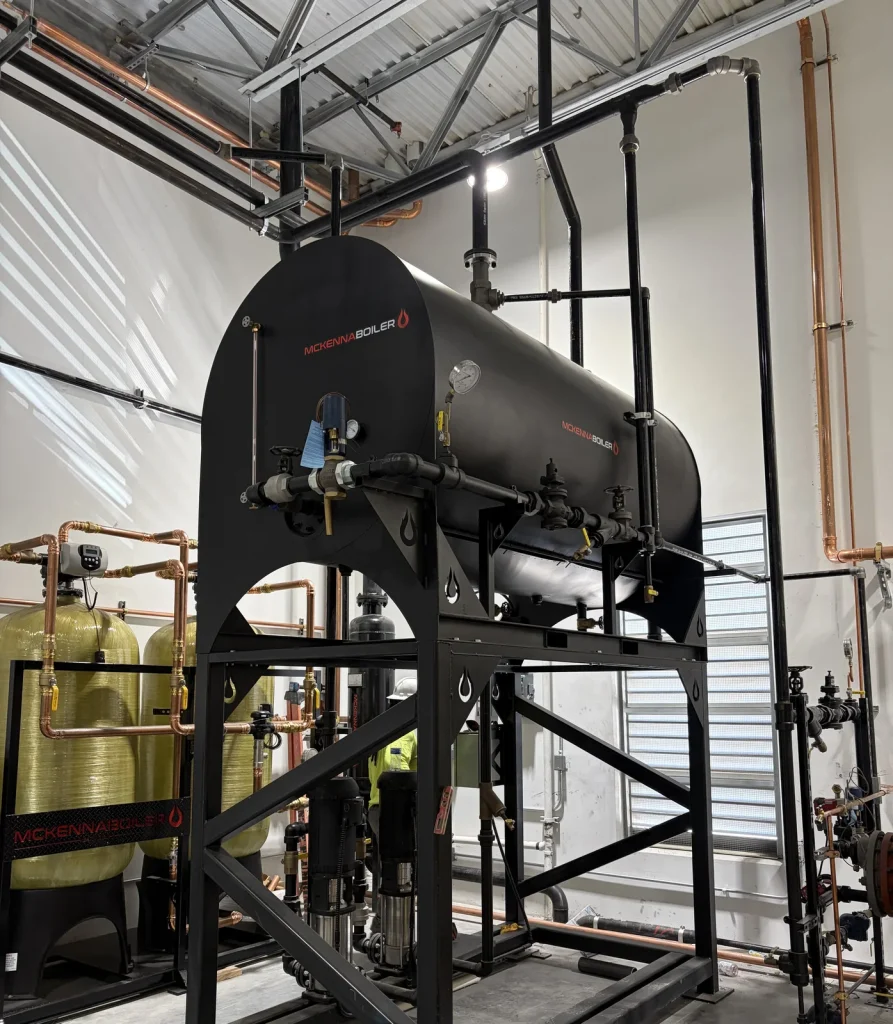
McKenna builds firetube boilers and feedwater systems and services steam plants across California. For definitions of the terms above, see the boiler glossary, or call (323) 987-1816.