

In California, a steam boiler that operates above 15 psi is a power boiler: it needs a Cal/OSHA permit to operate and an internal and external inspection every year, unless Cal/OSHA has approved a longer interval between internal inspections. Low-pressure heating boilers, miniature boilers, high-temperature water boilers, and some small boilers are not subject to the annual state inspection. Their controls must still be kept in operating condition, which is why they still need yearly service. McKenna Boiler Works, Inc. prepares boilers for inspection and services them, and this post covers what the rules require and what the inspection is meant to find.
Which California boilers need an annual inspection?
The definitions are in Title 8 Section 753 of the Boiler and Fired Pressure Vessel Safety Orders. Section 770 requires annual internal and external inspection, and Section 771 lists the boilers that are not subject to it.
| Boiler class | Definition (Title 8 Section 753) | Annual state inspection and permit to operate |
|---|---|---|
| Power boiler | Steam boiler operating above 15 psi | Yes, internal and external every year (Section 770) |
| Low-pressure boiler | Steam at or below 15 psi, or water at or below 160 psi and 250°F | Not subject (Section 771) |
| High-temperature water boiler | Heats water above 212°F at over 160 psi, or above 250°F at any pressure | Not subject (Section 771) |
| Miniature boiler | Shell 16 in. inside diameter or less, 5 cu. ft. gross volume or less, 20 sq. ft. heating surface or less, 100 psi or less | Not subject (Section 771) |
| Small boiler within Section 771 limits | 100 sq. ft. heating surface or less, steam drum 16 in. or less, 100 psi or less, 35 gal. water or less, burner input 400,000 Btu/hr or less | Not subject (Section 771) |
The exemption comes with conditions. An exempt boiler still has to meet the other provisions of the Safety Orders, including construction and installation. An automatically fired one needs the controls required for low-pressure boilers, and all automatic controls have to be kept in operating condition. A Cal/OSHA safety engineer can also require any exempt boiler to be prepared for inspection. Some cities and counties have boiler rules of their own, so check locally as well.
Can the internal inspection interval be extended?
Labor Code Section 7682 lets Cal/OSHA allow up to 36 months between internal inspections of a fired boiler when operating experience and design show that equivalent safety will be maintained. Section 770 sets the conditions. It offers the extension on individual application from petroleum companies, chemical plants, public utilities, and similar industries with superior preventive maintenance and examination programs. The applicant has to show a history of no significant deterioration, establish wall thickness reference points, and keep documented water chemistry records prescribed by a qualified water treatment company. The annual external inspection and permit renewal continue, and a boiler running more than 24 months between internal inspections needs an on-stream examination program acceptable to Cal/OSHA and the inspection agency. Where a local jurisdiction has its own boiler inspection rules, it must also be consulted on the inspection program.
Those conditions say a lot about what the annual internal inspection is for. Cal/OSHA will stretch the interval only when the records prove the water side is not deteriorating, and that proof comes from your water treatment program and your logs.
Why inspect every year?
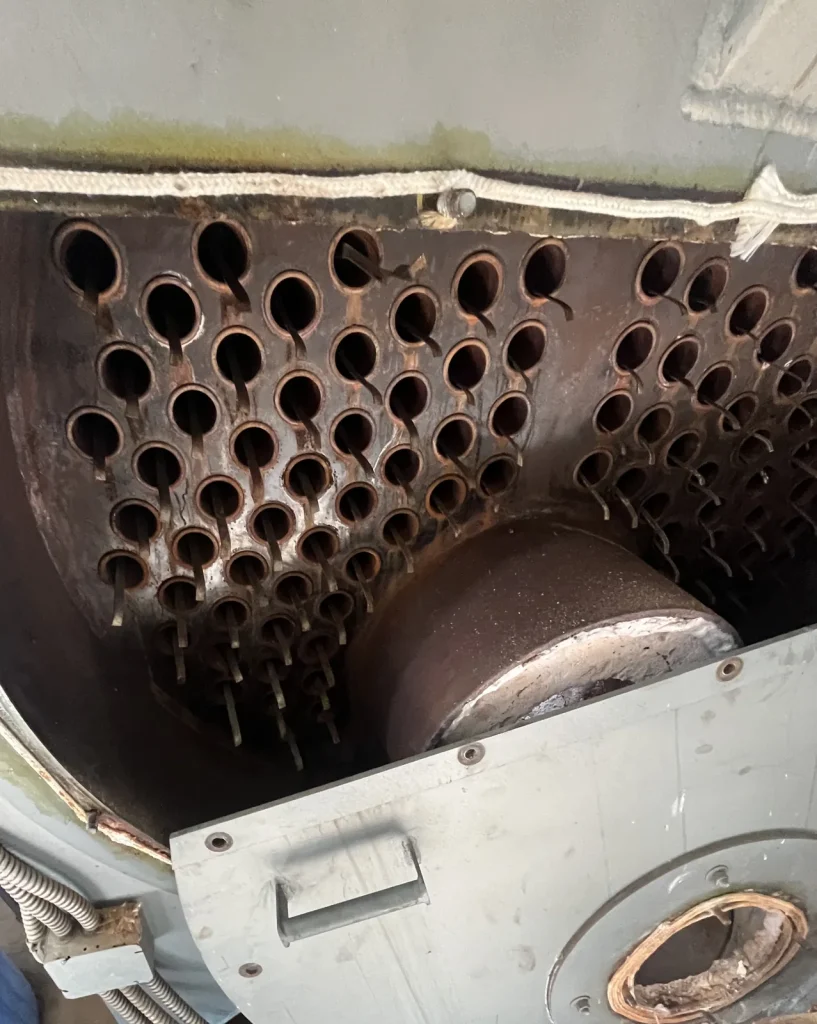
The damage that ends a boiler’s life happens inside it, where nobody can see it while it runs:
- Scale from hardness in the makeup water insulates the tubes and furnace, so the steel underneath runs hotter than the water around it.
- Dissolved oxygen causes pitting that thins tubes and shells from the water side.
- Repeated heating and cooling fatigues tube ends and tubesheets, and cracks start at the tube holes.
- Failed refractory exposes steel to flame and hot gas it was not designed to see.
- Sludge collects in low water cutoff chambers and gauge glass connections, and deposits can keep a safety valve from lifting at its set pressure.
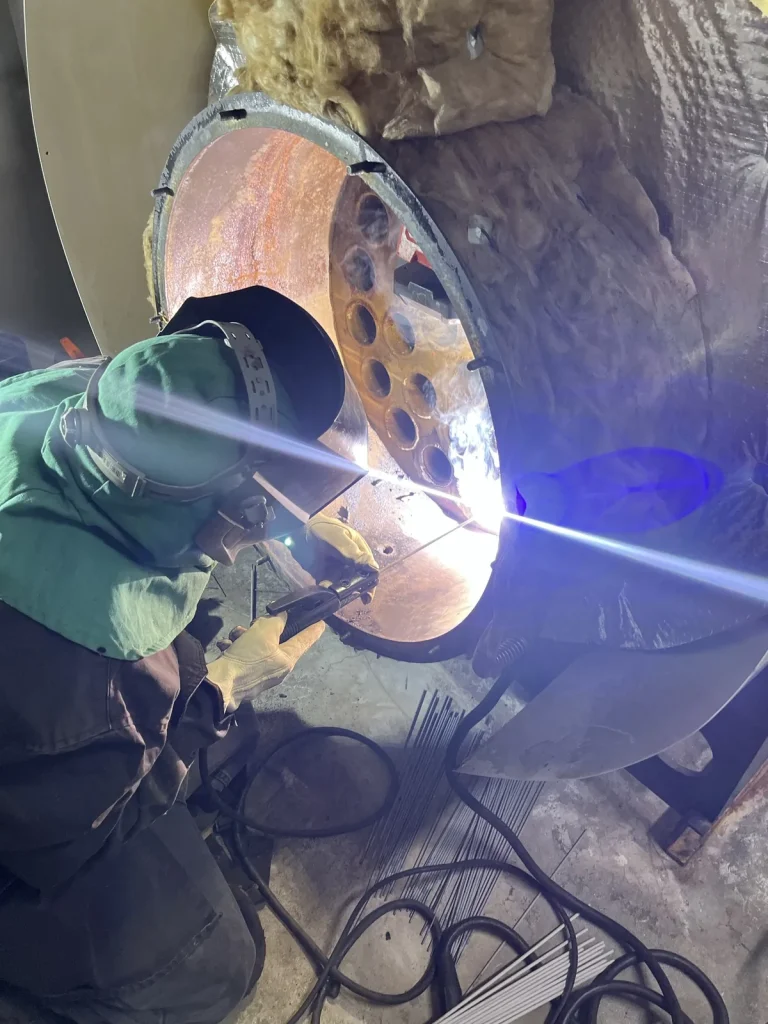
An internal inspection finds all of these while they are still repairable. A crack found at the tube end during an inspection is a planned repair; the same crack found as a leak is an unplanned outage.
What is the difference between the inspection and annual service?
The inspector examines the boiler’s condition and its safety devices and decides whether it can keep operating. The inspector does not tune the burner or repair the controls. Annual service covers the rest: combustion analysis and burner tuning, gas train and safety shutoff valve checks, flame safeguard checks, low water cutoff and limit control testing, and ASME CSD-1 checks where CSD-1 applies.
Air district rules add their own records. Depending on the boiler’s size and the district, South Coast AQMD Rules 1146, 1146.1, and 1146.2, the San Joaquin Valley rules, and Bay Area AQMD Regulation 9 Rule 7 can require periodic tune-ups, emissions checks, or source tests, with records you have to keep. Scheduling service on the same outage as the inspection keeps the downtime to one shutdown.
What to do
- Know your boiler’s class and the expiration date on its permit to operate.
- Schedule the inspection outage early, with service on the same shutdown.
- Have your water treatment company on site to check and monitor the water side when the boiler is opened.
- Keep the water treatment log, blowdown log, and control test logs current and at the boiler.
- Fix the inspector’s findings promptly, with welded pressure part repairs made under NBIC Part 3 by a National Board R certificate holder.
- For a low-pressure boiler, schedule yearly service anyway, and keep its controls tested and logged.
- Check what your insurance carrier and your city require in addition to Cal/OSHA.
Common questions
Who performs the annual inspection?
A qualified safety engineer employed by Cal/OSHA, or a certified inspector holding a certificate of competency, usually employed by the boiler’s insurance carrier. Either one inspects to the Boiler and Fired Pressure Vessel Safety Orders.
My boiler is low pressure. Do I need to do anything?
Yes. Its automatic controls must be kept in operating condition even without the annual state inspection, and Cal/OSHA can still require an inspection. Yearly service and logged control tests are how you show that.
What is a permit to operate?
It is Cal/OSHA’s authorization to operate a boiler subject to inspection, issued when the boiler passes. For a power boiler it is renewed with each annual inspection, so check the expiration date on yours and schedule ahead of it.
If my internal interval is extended, does the boiler skip inspection?
No. The annual external inspection and permit renewal continue every year. The extension applies only to the internal inspection and depends on the boiler’s records.
Does my city have its own boiler rules?
Some do. Section 770 says a local jurisdiction with its own boiler inspection regulations must be consulted before an extended inspection program is accepted. Check with your city or county for any local requirements.
McKenna handles boiler inspection preparation and testing and offers annual service contracts that put the service and the inspection outage on one schedule. To plan your next inspection, call (323) 987-1816.