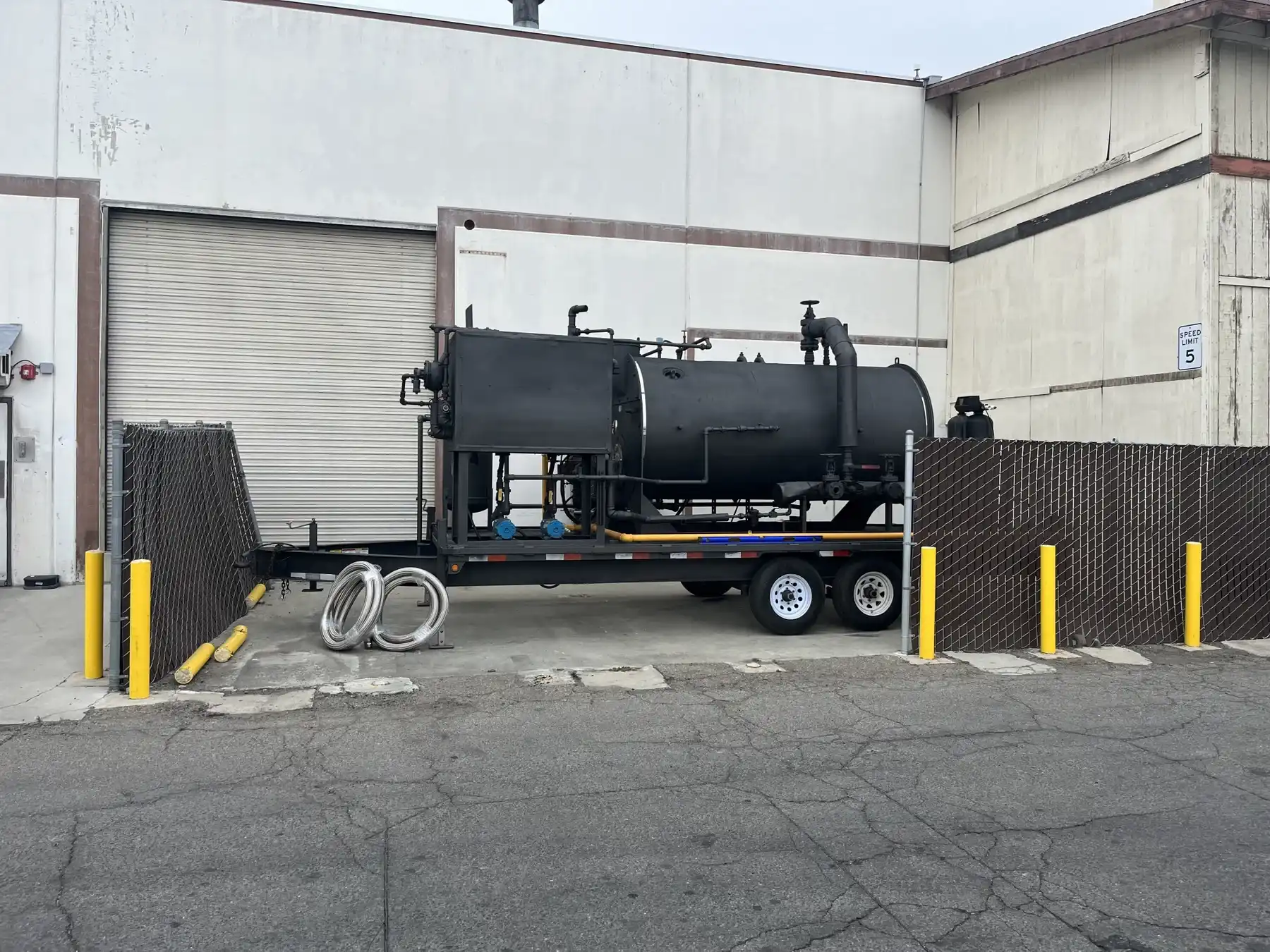
When a boiler fails and the repair will take days or weeks, a rental boiler can carry the steam or hot water load while the permanent unit is repaired, retubed, or replaced. McKenna Boiler Works, Inc. has rental boilers for this, and how fast one runs at your plant depends mostly on two things: how much McKenna knows about your load on the first call, and how ready your connection points are when the truck arrives.

What should happen in the first hours after a boiler fails?
Make the failed boiler safe before anyone thinks about a rental. If the failure involves low water and the level is out of sight in the gauge glass, shut the burner off and do not add feedwater to a hot boiler. Cold water on overheated tubes and tube sheets can crack them or loosen tube ends, and a dry-fired boiler has to be inspected before it is refilled. If the flame safeguard has locked out, do not keep resetting it; repeated restarts can put unburned fuel in the furnace. Follow the manufacturer’s instructions and your site’s lockout/tagout procedure for the burner, fuel, and electrical supply.
Next, sort the loads. Most plants have a few loads that cannot stop (sterilizers, a cook kettle line, domestic hot water in a hospital, building heat in cold weather) and others that can wait. A rental sized for the critical loads arrives and connects faster than one sized for the whole plant, and you may already have a second boiler that can carry part of the load while the rental is set.
What information sizes an emergency rental?
A rental has to match the steam pressure or water temperature your equipment needs and carry the load at that condition. Load is usually stated in pounds of steam per hour (lb/hr), boiler horsepower, or thousand Btu per hour (MBH). One boiler horsepower is 33,475 Btu/hr, or 34.5 lb/hr of steam from and at 212°F, so a 200 hp boiler is roughly 6,900 lb/hr from and at 212°F. The boiler sizing calculator converts between these units.
| Item | Why it matters | Where to find it |
|---|---|---|
| Operating pressure or supply water temperature | Sets the rental’s pressure rating and safety valve setting | Boiler data plate, operating log, process equipment specs |
| Load to carry (lb/hr, hp, or MBH) | Sets rental size; undersizing drops pressure, oversizing short-cycles | Failed boiler rating, steam meter, fuel meter readings |
| Fuel and gas pressure at the tie-in | The burner needs its rated supply pressure at full fire flow | Gas meter and regulator tag, utility account |
| Electrical service (voltage, phase, amps) | Burner blower, feedwater pumps, controls | Panel schedule near the boiler room |
| Feedwater, condensate, and makeup water | Decides whether the rental uses your feedwater system or brings its own | Feedwater tank and pump nameplates |
| Placement and access | Truck route, crane or forklift, distance to tie-in points, stack clearance | Site plan, photos of the yard or dock |
What permits apply to a rental boiler in California?
The customer is responsible for all permits for a rental boiler. Two agencies matter. Cal/OSHA’s Boiler and Fired Pressure Vessel Safety Orders (Title 8) require inspection and a permit to operate for power boilers, which in practice means steam boilers above 15 psig; low-pressure boilers are exempt from the annual inspection and permit under 8 CCR 771 as long as their controls are fitted and kept working. Confirm with McKenna how the rental’s inspection status applies at your site before it fires.
The local air district is the second. Some McKenna rental boilers carry South Coast AQMD permits, which can shorten the path inside the South Coast AQMD area: all of Orange County, the non-desert parts of Los Angeles, Riverside, and San Bernardino Counties, and the Coachella Valley. In the San Joaquin Valley, the Bay Area, and other districts, check the district’s rules for temporary or portable units before the rental runs, and read any permit conditions on fuel, location, and hours.
How is a rental tied in and started?
The tie-in can be done by your plant crew, your mechanical contractor, or McKenna. Whoever does it, the rental connects at points you choose ahead of time: a steam header or hot water supply and return, a gas line with an isolation valve, electrical power, feedwater or makeup water, and a drain for blowdown. Blowdown water leaves a steam boiler at saturation temperature, so it goes to a blowdown tank or separator that cools it before it reaches the drain; plumbing codes and local sewer rules limit discharge temperature.
Two details are easy to miss under pressure. First, the failed boiler must be isolated so the rental cannot backfeed it while crews work on it: closed and locked steam stop valves, the non-return or check valve where one is fitted, and a lockout on its fuel and power. Second, the rental needs treated water from the first hour. Your water treatment company sets the program and should set up chemical feed and testing for the rental, since untreated makeup water can start scaling or pitting a rental boiler quickly.
McKenna does the startup and commissioning: verifying the low water cutoffs and flame safeguard, checking the safety valve setting against the system, and tuning combustion to the air permit limit.
What to do: emergency rental checklist
- Make the failed boiler safe: burner off, fuel and power locked out per your site’s procedures, no feedwater added to a boiler that ran low.
- List the loads that cannot stop and the pressure or temperature each one needs.
- Pull the failed boiler’s data plate rating and the last few days of log readings.
- Photograph the yard or dock where a trailer could sit, and the route in.
- Find the nearest gas line, electrical panel, steam header, and feedwater connection to that spot.
- Call your water treatment company so treatment is ready when the rental fills.
- Call (323) 987-1816 with that information in hand. A live person answers 24/7.
- Before the rental fires, confirm the failed boiler is isolated and tagged, and that the air permit and Cal/OSHA status are settled.
Common questions
How fast can a rental boiler be running?
It depends on rental availability for your pressure and size, distance, permits, and how ready the connection points are. Plants that have tie-in points already planned connect much faster than plants that start from scratch. Have the checklist information ready on the first call.
Can a rental carry the whole plant?
Sometimes. Rentals come in fixed sizes, and a large plant may need more than one unit, or a rental sized for critical loads while a second permanent boiler carries the rest. Sizing to the real load, measured from fuel or steam meters, avoids renting more capacity than you can connect.
Does a rental boiler need its own air permit?
It needs to be covered by an air district permit or exemption where it runs. Some McKenna rental boilers carry South Coast AQMD permits. Outside that district, check your district’s rules for temporary units before the rental fires.
Who is responsible for water treatment on a rental?
Your water treatment company sets the program for the rental the same way it does for your permanent boiler. Ask them to be ready when the rental fills, and keep testing and logging while it runs. McKenna is not a water treatment company.
Should we plan a rental before anything fails?
Yes. Choosing a location, tie-in points, and the needed size ahead of time removes most of the delay in an emergency. A plant that will also need a rental for a scheduled retube or replacement can use the same plan for both.
Getting a rental started
For rental availability, sizes, and which units carry South Coast AQMD permits, see McKenna rental boilers and emergency boiler service, or call (323) 987-1816. A live person answers 24/7.