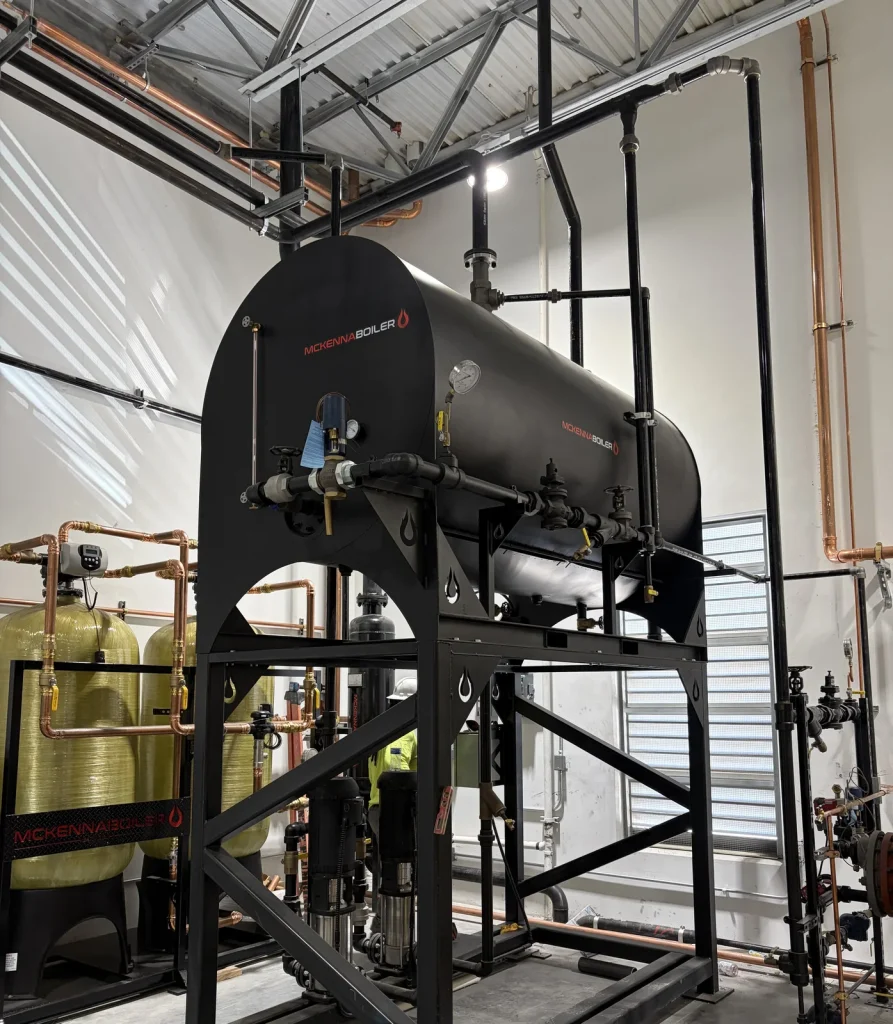

Plants heat with saturated steam because it gives up a large amount of heat, its latent heat, at one fixed temperature when it condenses, and that temperature is set by the steam pressure. So the right pressure is the lowest one that gives the process the temperature it needs, delivered as dry steam with the condensate drained and returned. McKenna Boiler Works, Inc. builds firetube, firebox, and vertical steam boilers for process steam, sterilization, and building heat.
How are steam pressure and temperature linked?
When water and steam are together in a boiler, they are at saturation: each pressure has exactly one temperature. Raise the pressure and the boiling point rises. This is why a steam system can control temperature by controlling pressure.
| Pressure (psig, at sea level) | Saturation temperature (°F) | Latent heat (Btu/lb) | Specific volume (ft³/lb) |
|---|---|---|---|
| 0 | 212 | 970 | 26.8 |
| 15 | 250 | 946 | 13.9 |
| 50 | 298 | 912 | 6.7 |
| 100 | 338 | 881 | 3.9 |
| 150 | 366 | 857 | 2.8 |
Two trends in the table drive system design. First, latent heat falls as pressure rises, because more of the energy is already in the hot water as sensible heat. A pound of low-pressure steam delivers more usable heat when it condenses. Second, specific volume falls sharply with pressure. Steam at 100 psig takes up about one seventh the space of steam at 0 psig, so it moves through much smaller pipe.
That is why many plants generate at a higher pressure, distribute it, and reduce the pressure with a pressure reducing valve near the equipment. Steam tables use absolute pressure; gauge pressure is absolute minus atmospheric, so at altitude the same gauge reading gives a slightly lower temperature.
Why is saturated steam better than superheated steam for process heat?
Condensing steam transfers heat at a very high rate and at a constant temperature. The heat exchanger surface sees the saturation temperature everywhere the steam condenses, which makes control simple and heating even.
Superheated steam is steam heated above its saturation temperature. It has to cool to saturation, giving up only sensible heat at a falling temperature and a much lower transfer rate, before it condenses. That makes it a poor heating medium. Superheat belongs in power generation, where it protects turbine blades from water droplets. Plant boilers like the firetube boilers McKenna builds produce saturated steam.
What is wet steam, and why does it matter?
Steam leaving a boiler carries some water droplets. Dryness fraction is the share of the mixture that is vapor: steam at 95 percent dryness carries 5 percent water by weight and delivers only 95 percent of the latent heat.
Wet steam causes more trouble than lost heat. Water films on heat transfer surfaces and slows heating, droplets erode valves and fittings, and slugs of water cause water hammer. Common causes are a high water level, high dissolved solids that make boiler water foam, and sudden load increases that drop pressure and make the boiler water swell.
The fixes are holding the normal water level, keeping dissolved solids in range with blowdown to the water treatment program, separators on the steam line, and drip legs with traps at low points and ahead of control valves. Air and other non-condensable gases also hurt heating, because they collect at heat transfer surfaces and insulate them. Thermostatic air vents remove them.

What steam pressure does sterilization need?
Steam sterilizers run on saturated steam at set temperatures, held for set times. Gravity cycles commonly run at 250°F, about 15 psig in the chamber. Pre-vacuum cycles commonly run at 270°F to 275°F, roughly 27 to 31 psig in the chamber.
The supply has to be higher than chamber pressure to allow for pressure reducing valves and line losses, so hospital and laboratory sterilizers are fed from a high-pressure steam source, typically a power boiler built under ASME Section I. The sterilizer manufacturer sets the required supply pressure and steam quality, and sterilization standards call for dry, saturated steam with minimal non-condensable gases. A low-pressure boiler, limited to 15 psig, cannot supply a sterilizer.
Where does the 15 psig line come from?
ASME Section IV covers heating boilers that make steam at 15 psig or less. Above 15 psig, the boiler is a power boiler under ASME Section I, with heavier construction rules and stricter inspection. The line also matters in California: power boilers need an annual Cal/OSHA inspection and permit to operate, while low-pressure boilers are exempt from the annual inspection under Title 8, section 771, though they must still meet the Safety Orders.
Low-pressure steam serves building heat and some process loads. Process work that needs temperatures above about 250°F, including sterilization, needs a high-pressure boiler.
What to check: getting the most from your steam
- Choose the lowest steam pressure that gives the process its temperature, with margin for the temperature difference across the heat exchanger.
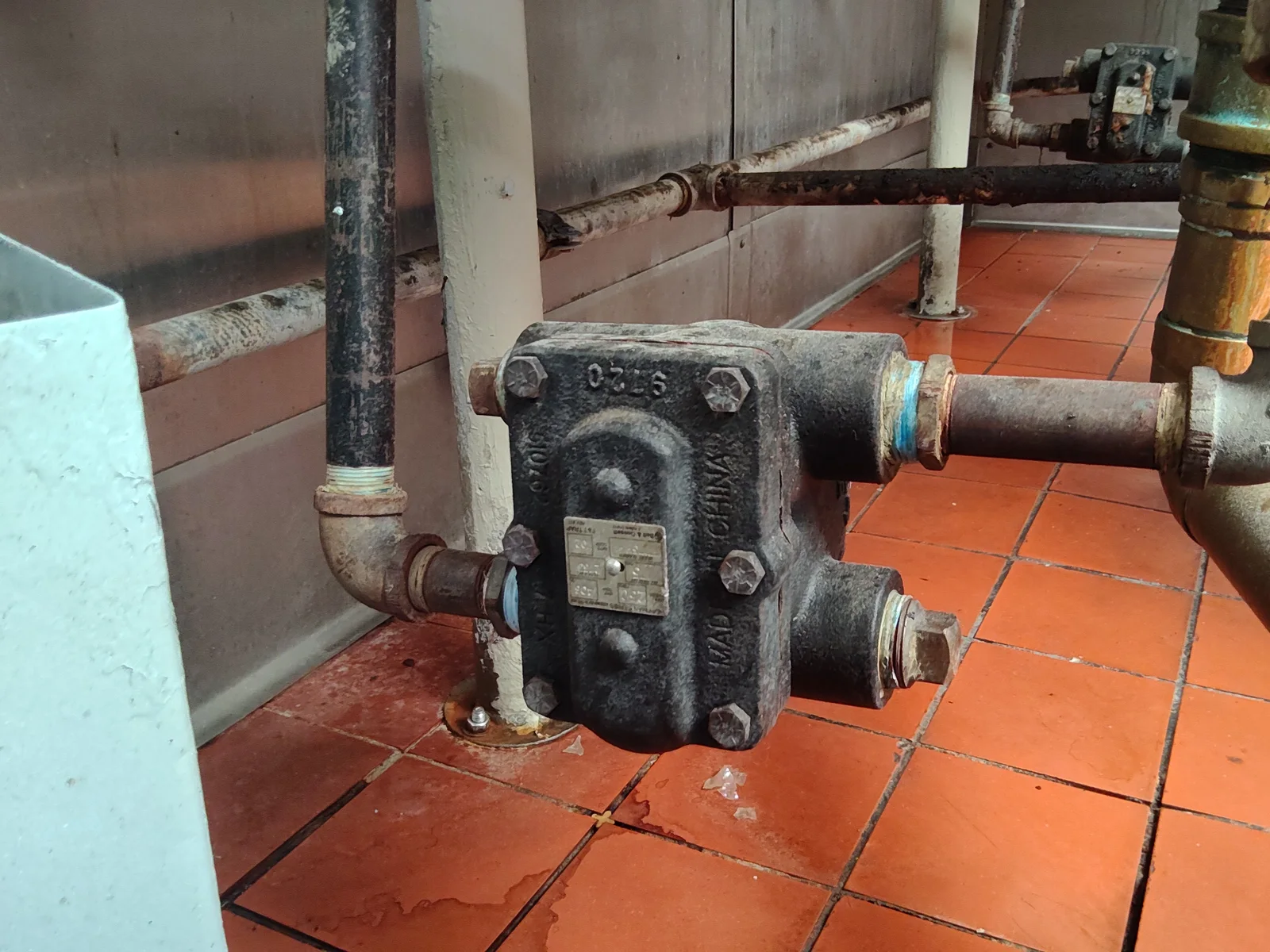
- Survey steam traps. A trap that fails open blows live steam into the condensate line; one that fails closed backs condensate into the equipment, causing cold spots and water hammer. See steam trap audits.
- Return condensate. It is hot, already treated water, and every pound returned is a pound of makeup that does not have to be heated and treated. See feedwater systems.
- Watch for wet steam: water hammer, wet end users, or rising conductivity in the condensate, which points to carryover from the boiler.
- Insulate steam and condensate lines, valves, and fittings.
- Never open a steam line, trap, or strainer under pressure. Isolate it, let it depressurize and cool, and drain it first, and follow lockout/tagout, the manufacturer’s instructions, and your site’s procedures.
Common questions
How much heat does one pound of steam deliver?
Mostly its latent heat at the operating pressure: about 970 Btu at 0 psig, 946 Btu at 15 psig, and 881 Btu at 100 psig. A little more comes from cooling the condensate if it leaves the equipment below saturation temperature.
What is flash steam?
When hot condensate drops to a lower pressure, part of it boils instantly because it holds more heat than water can at the lower pressure. Condensate at 100 psig released to atmosphere flashes about 13 percent of its weight to steam, which can be recovered in a flash tank.
What is boiler horsepower?
One boiler horsepower is the heat to evaporate 34.5 pounds of water per hour from and at 212°F, which is 33,475 Btu/hr. Actual steam output at your pressure and feedwater temperature is somewhat lower. The boiler sizing calculator works through it.
Is higher steam pressure more efficient?
Not for heating. Higher pressure means a higher saturation temperature, which raises boiler stack temperature and radiation losses, and each pound of steam carries less latent heat. Generate at the pressure distribution needs and reduce it near the load.
Can a low-pressure boiler supply a sterilizer?
No. Sterilizers need supply pressure above 15 psig, so they are fed from a high-pressure steam source, typically a boiler built under ASME Section I. When you ask McKenna Boiler Works, Inc. about a boiler for sterilizers, have the sterilizer maker’s required supply pressure and steam demand ready.
To size a steam boiler for your process temperatures and load, see McKenna firetube boilers or call (323) 987-1816.