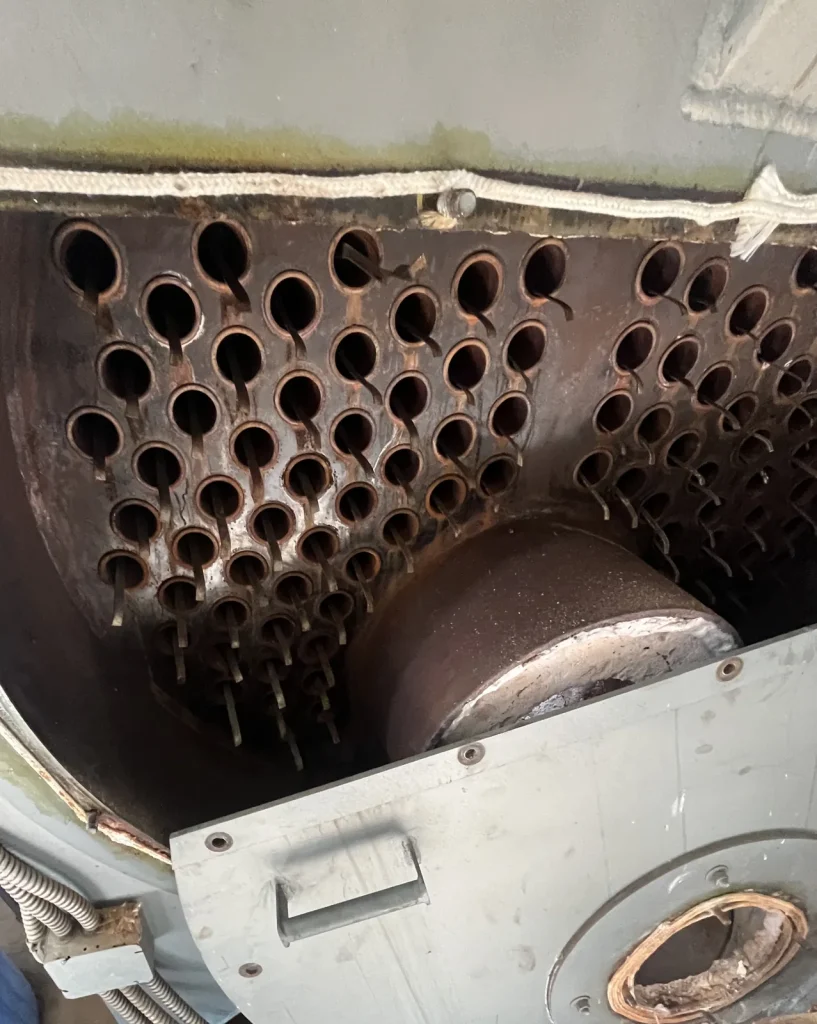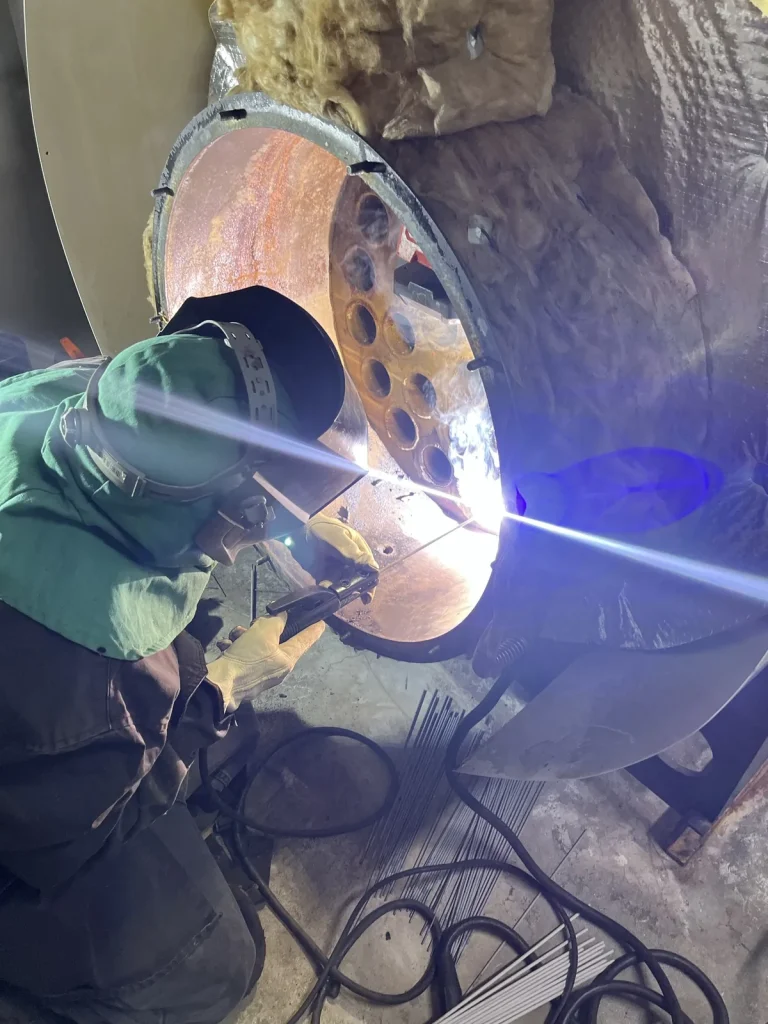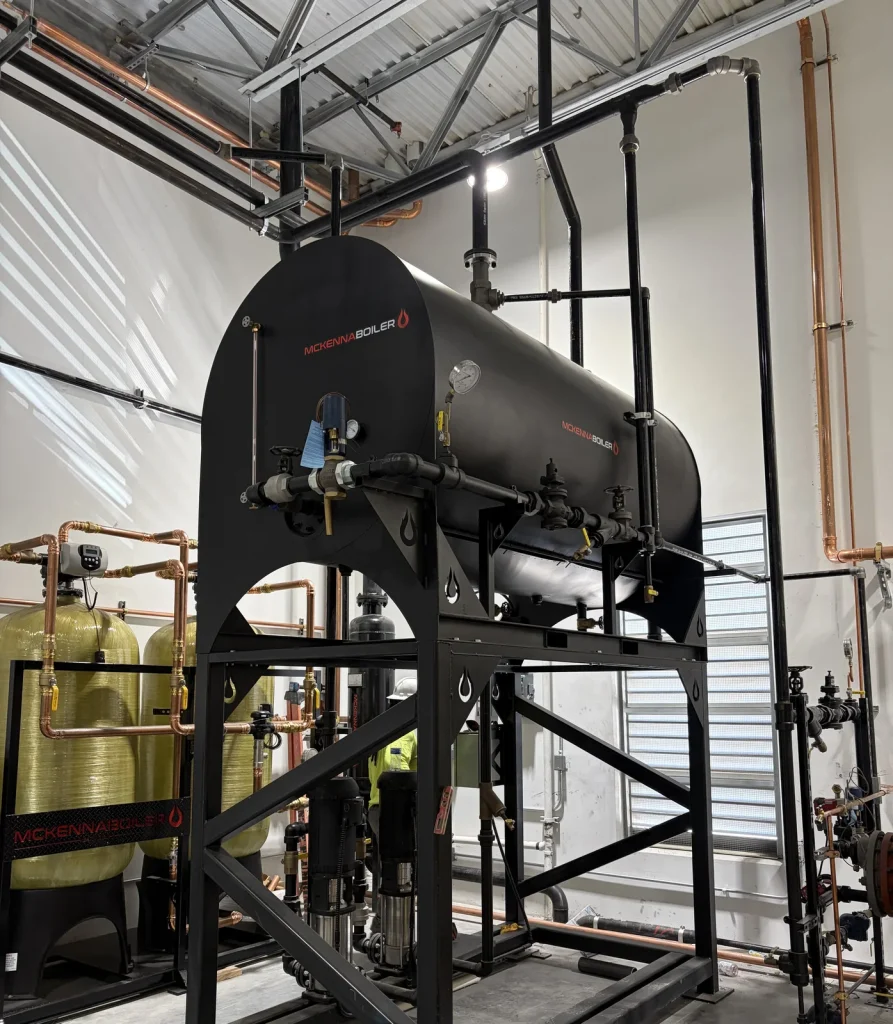


A commercial firetube boiler is built almost entirely of carbon steel: plate for the shell, tube sheets, and furnace, and carbon steel tube for the fire tubes. Other metals appear where the job differs: cast iron in sectional heating boilers, copper in some hot water heaters, and stainless steel in condensing heat exchangers, some feedwater tanks, and condensate equipment. McKenna Boiler Works, Inc. builds firetube, firebox, and vertical boilers in California, and this post walks through which metal goes into each part of a commercial boiler and why the choice matters once the boiler is in service. The code side, meaning ASME material specifications, allowable stresses, and material traceability, is covered in a separate post.
Which metal goes into each part of a firetube boiler?
| Part | Typical material | What the part has to do |
|---|---|---|
| Shell | Carbon steel plate, commonly SA-516 Grade 70 | Hold pressure; resist corrosion on the water side through water chemistry |
| Tube sheets | Carbon steel plate, commonly SA-516 Grade 70 | Hold the tube ends tight through thousands of heating and cooling cycles |
| Furnace (combustion chamber tube) | Carbon steel plate, plain or corrugated | Carry the highest heat flux and resist collapse under external pressure |
| Fire tubes | Carbon steel boiler tube such as SA-178 or SA-192 | Transfer heat from gas to water and seal at rolled or welded ends |
| Stays and braces | Carbon steel bar or tube | Support flat surfaces such as tube sheets against pressure |
| Nozzles, flanges, piping | Carbon steel pipe and forgings | Connect steam, feedwater, blowdown, and safety valves |
| Doors and refractory | Steel plate with castable or fiber refractory | Turn the gas between passes and protect the steel from direct flame |
Why carbon steel for the pressure parts?
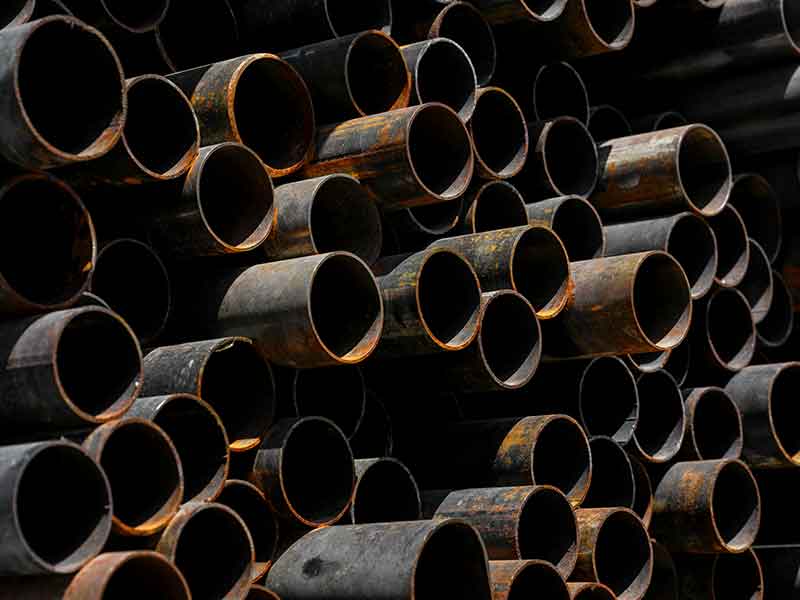
Carbon steel does three things a boiler needs, at a lower cost than alloys. It holds its strength at the temperatures a firetube boiler’s metal sees, typically a little above the water temperature. It conducts heat well: carbon steel’s thermal conductivity is roughly three times that of austenitic stainless steel, so a carbon steel tube runs cooler for the same heat flux. And it forms, rolls, and welds reliably, which matters for rolled tube ends and for repairs decades later.
Its weakness is corrosion, and the boiler handles that through water chemistry. In hot, oxygen-free, slightly alkaline water, carbon steel forms a thin, tight layer of magnetite (black iron oxide) that protects it. No coating is applied to the water side. Damage starts when oxygen, low pH, or concentrated caustic attacks that layer, which is why the feedwater and boiler water program matters so much. Your water treatment company sets that program.
Where do stainless steel and copper fit?
Stainless steel earns its place where carbon steel would corrode and the magnetite layer cannot protect it: condensing boiler heat exchangers, where acidic flue gas condensate wets the metal; feedwater tanks, where some owners specify stainless because oxygenated water at feed temperature can pit carbon steel; and condensate receivers and piping, which carry carbonic acid. Austenitic stainless (Types 304 and 316) stays off the water side of a steam boiler, though. In warm water containing chlorides, and where boiler water concentrates under deposits, these alloys are prone to stress corrosion cracking, which can crack through the wall with little visible warning.
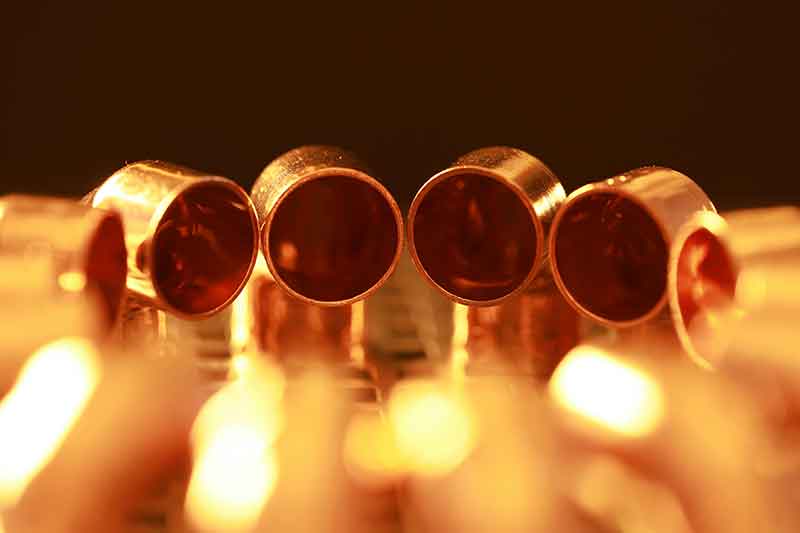
Copper and copper alloys conduct heat far better than steel and are used in some finned-tube hot water heaters and in heat exchangers. They are a poor fit for steam boiler pressure parts. Copper is attacked by ammonia, which some water treatment amines and makeup waters introduce into steam and condensate, and copper dissolved upstream can plate out on steel inside a boiler and drive pitting. If your system has copper heat exchangers, tell your water treatment company so the program accounts for it.
What about cast iron boilers?
Cast iron sectional boilers are built under ASME Section IV for low-pressure steam (15 psig or less) and hot water heating. Cast iron resists corrosion well and the sections can be assembled in a tight room, but it is brittle compared with steel and does not tolerate thermal shock: cold makeup water into a hot section can crack it. Cast iron boilers suit building heat. Industrial process steam above 15 psig is a job for a steel boiler built under ASME Section I.
What to check: protecting the metal in service
- Keep the water treatment program running as your water treatment company sets it; the magnetite layer is the boiler’s corrosion protection.
- Keep feedwater hot and oxygen low, per the program, to protect the shell and tubes from pitting.
- Avoid thermal shock: warm the boiler slowly from cold, as the manufacturer specifies, and never add cold feedwater to a boiler that ran low. If water is out of sight in the gauge glass, shut off the burner and call for service.
- Watch condensate return lines for thinning and rust-colored condensate, signs of carbonic acid attack.
- Tell your water treatment company about any copper or stainless heat exchangers in the system.
- For any repair to a pressure part, require code materials that match the original design. Welded repairs, such as seal-welded tubes or tubesheet repairs, are made under the NBIC by a National Board R certificate holder and accepted by an Authorized Inspector. In most cases, replacing rolled and beaded tubes is not an R stamp repair; check with your Authorized Inspector.
- Follow lockout/tagout and your site’s procedures before opening the boiler for inspection.
Common questions
What metal are commercial boiler tubes made of?
Firetube boiler tubes are usually carbon steel boiler tube, such as SA-178 (electric-resistance-welded) or SA-192 (seamless). Carbon steel conducts heat well, rolls tightly into tube sheets, and is protected on the water side by a magnetite layer when water chemistry is controlled.
Why not build a steam boiler out of stainless steel?
Austenitic stainless steel conducts heat about a third as well as carbon steel and is prone to stress corrosion cracking in warm water with chlorides or concentrated boiler water. Carbon steel with good water treatment is the standard choice for a steam boiler’s water side. Stainless is used for feedwater tanks, condensate equipment, and condensing heat exchangers.
Are boiler water sides coated to prevent corrosion?
No. The protection is a magnetite layer that forms naturally on carbon steel in properly treated water. Keeping that layer intact is the job of the feedwater and boiler water program your water treatment company sets.
Can a cast iron boiler be used for process steam?
Cast iron sectional boilers are limited to low-pressure steam (15 psig or less) and hot water under ASME Section IV. Most process loads need higher pressure, which means a steel power boiler built under ASME Section I.
Can tubes in an older boiler be replaced with a different tube material?
Replacement tubes must be a material acceptable under the original construction code and the NBIC, documented by mill test reports, and the change must be accepted by the Authorized Inspector. In practice most firetube retubes use the same carbon steel boiler tube specification as the original.
Retubes, repairs, and new boilers
For tube replacement, see boiler retubes; for code repairs, see R certificate repairs. McKenna builds firetube boilers standard or custom-sized. Call (323) 987-1816.