
A hospital uses steam for sterilizers, humidification, kitchens, and laundry, and hot water for building heat and domestic hot water, so its boiler plant has to keep running through a boiler failure, a service outage, or an inspection. McKenna Boiler Works, Inc. builds and services boilers for California facilities, including hospitals, where losing steam affects patient care. This post explains what a hospital boiler plant serves, which codes apply, and how to set it up and run it so the steam never stops.
What does a hospital use steam and hot water for?
- Sterilizers. Steam sterilizers in sterile processing and surgery depend on a steady supply of saturated steam at the pressure the sterilizer manufacturer specifies. This is usually the load that sets the plant’s steam pressure.
- Humidification. Operating rooms and other critical spaces have humidity ranges set by their design standards. Boiler water treatment chemicals can carry over into steam, so the engineer of record and the water treatment company decide whether plant steam can be injected into air handlers or whether a separate clean steam generator is needed.
- Kitchens and laundry. Steam kettles, dishwashers, ironers, and dryers in larger facilities.
- Building heat and domestic hot water. Often from steam-to-water heat exchangers in the plant, or from separate hot water boilers.
What steam quality does a sterilizer need?
Steam sterilization works because saturated steam condenses on the load and releases its latent heat, about 880 Btu per pound at 100 psig, at a fixed temperature. Three things spoil that:
- Wet steam. Water droplets carried with the steam add little heat and leave wet packs. Carryover from a boiler running with high water level, high dissolved solids, or foaming is a common cause.
- Non-condensable gases. Air and carbon dioxide in the steam form a film on the load that slows heat transfer and can leave cold spots.
- Superheat. Steam above saturation temperature behaves like hot gas until it cools, and it does not sterilize as reliably.
AAMI ST79 is the U.S. practice guide for steam sterilization in healthcare facilities, and EN 285 describes the steam quality tests (dryness, non-condensable gases, superheat) that many sterilizer manufacturers reference. On the plant side, good steam quality comes from a properly sized boiler that is not overfired, a water level held steady by the feedwater controls, total dissolved solids held within the boiler manufacturer’s limits and the program the water treatment company sets, separators and drip legs with working steam traps ahead of each sterilizer, and condensate returned hot to a feedwater system that drives off oxygen and carbon dioxide.
Which codes and permits apply to a hospital boiler plant?
| Item | Steam above 15 psig or hot water above 160 psig or 250°F | Steam at 15 psig or less, hot water at 160 psig and 250°F or less |
|---|---|---|
| ASME construction | Section I (power boiler) | Section IV (heating boiler) |
| Cal/OSHA | Permit to operate and periodic inspection (8 CCR 771 lists high-temperature water boilers among those not subject to annual inspection or a permit, under its conditions) | Not subject to annual inspection or a permit to operate under 8 CCR 771, but must still meet the Safety Orders and keep automatic controls working |
| Controls | ASME CSD-1 for automatically fired boilers under 12.5 million Btu/hr input; NFPA 85 at 12.5 million Btu/hr and above | |
Sterilizers need steam well above 15 psig, so most hospital steam plants are power boilers. On top of the boiler rules, CMS and The Joint Commission survey hospitals to NFPA 99 (Health Care Facilities Code) and NFPA 101 (Life Safety Code); CMS adopted the 2012 editions of both in 2016. The Joint Commission’s Environment of Care standards also expect utility systems, including the boiler plant, to be maintained, tested, and documented. In California, boiler replacements in licensed hospital buildings generally go through plan review by HCAI (formerly OSHPD); confirm the path with the facility’s engineer of record. The local air district sets burner emissions limits, for example South Coast AQMD Rules 1146, 1146.1, and 1146.2 depending on burner size.
How should the plant be set up so steam never stops?
- N+1 redundancy. With the largest boiler out of service, the remaining boilers should carry the design load. Many hospitals run two or three firetube boilers with one in reserve.
- A standby that is ready. A reserve boiler that has not been fired in months may not start when needed. Rotate lead and lag, and keep the standby filled, treated, and tested on a schedule.
- Redundant feedwater pumps and fuel. One feed pump or one gas regulator should not be able to take the plant down. Many hospitals keep a backup fuel arrangement where the permit and the burner allow it.
- Emergency power for burners, feed pumps, and controls, so the plant can run when utility power is lost.
- A temporary boiler plan. Know where a rental boiler would sit and how it would connect, before a major repair or replacement.
- Condensing boilers only where they fit. Condensing boilers are hot water boilers that need return water below about 130°F; they suit low-temperature heating loops and play no part in the sterilizer steam supply.
What to check and what to do
Follow the boiler and burner manufacturer’s instructions, lockout/tagout, and the facility’s procedures for every test.
- Every shift: log steam pressure, water level in the gauge glass, feedwater tank temperature, stack temperature, and any alarms. Note any wet packs reported by sterile processing.
- Low water cutoffs: test on the schedule in the manufacturer’s manual and CSD-1. If the burner does not shut off when the cutoff is reached, shut the burner off manually and call for service before returning the boiler to service.
- Flame safeguard and limits: have a qualified technician test flame failure response, high limits, and fuel valve proving on schedule, and keep the records for surveys.
- Safety valves: test and replace on the manufacturer’s and inspector’s schedule. Never adjust or block one.
- Water treatment: the facility’s water treatment company sets the chemical program, tests the water, and should be on site during inspections to check and monitor the water side.
- Steam traps ahead of sterilizers: check them at least yearly; a failed-closed trap floods the supply and causes wet steam.
- Plan outages with surgery and sterile processing schedules, and confirm the standby boiler is on line before taking a boiler down.
- Annual service and combustion tuning before each Cal/OSHA inspection, with the tuning report kept for the air district.
Common questions
Can a hospital run its sterilizers from a hot water boiler?
No. Sterilizers need saturated steam at a pressure set by the sterilizer manufacturer, so they need a steam boiler or a dedicated steam generator. Hot water boilers serve heating loops and domestic hot water.
What does N+1 mean for a boiler plant?
It means the plant can carry its design load with any one boiler out of service. For example, a hospital that needs two boilers at peak installs three. The extra boiler covers failures, annual service, and inspections.
Who is responsible for boiler water chemistry in a hospital?
The facility’s water treatment company sets the program, supplies the chemicals, and tests the water. They should be on site during inspections to check the water side. Plant staff run the daily tests and blowdown the program calls for.
Do hospital boilers need a Cal/OSHA permit?
Power boilers, which includes most hospital steam boilers, need a Cal/OSHA permit to operate and periodic inspections. Low-pressure heating boilers are exempt from the annual inspection and permit under 8 CCR 771, but they must still meet the Safety Orders and keep their automatic controls working.
What causes wet packs in sterilizers?
Common plant-side causes are wet steam from carryover, failed steam traps or missing drip legs ahead of the sterilizer, and condensate collecting in the supply line. The sterilizer and its loading also play a part, so plant staff and sterile processing should look at the problem together.
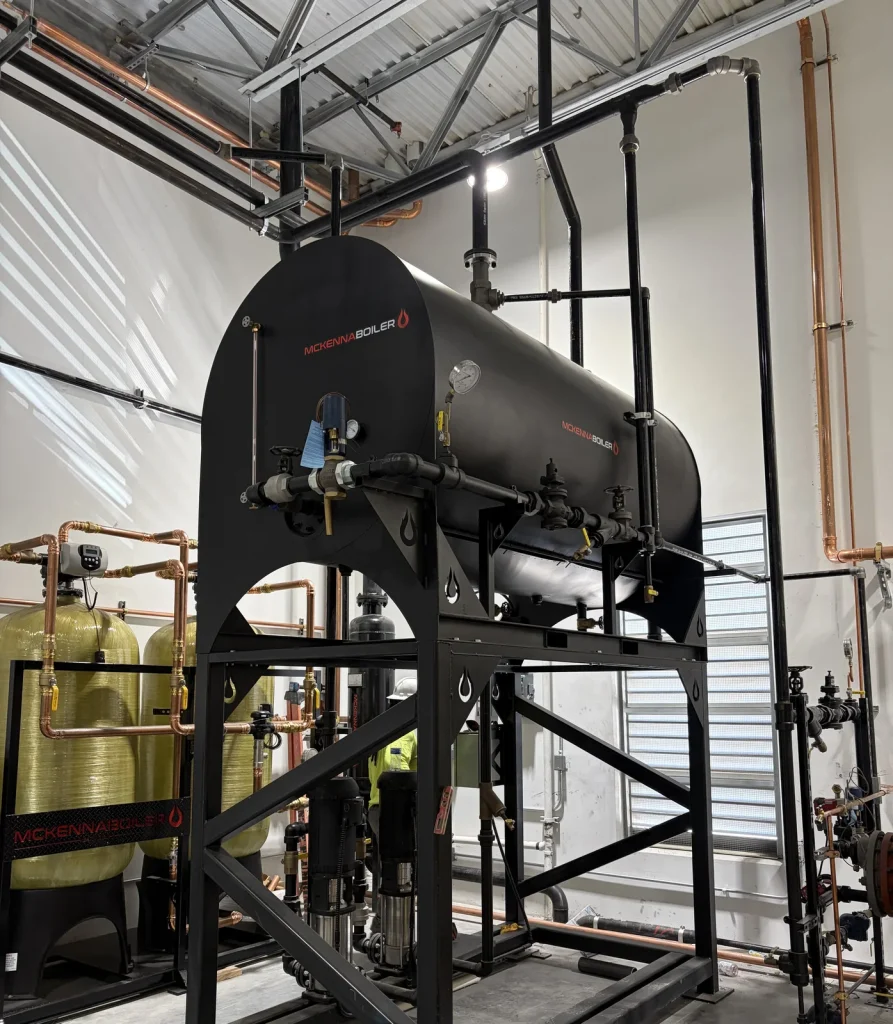
McKenna Boiler Works, Inc. builds turnkey boiler systems in California, including firetube boilers, feedwater systems, and blowdown tanks, and services and repairs other brands in hospitals across Los Angeles and all of California. For scheduled testing, tuning, and inspection preparation, see annual service contracts, or for a boiler that is down, emergency service. A live person answers 24/7: call (323) 987-1816.