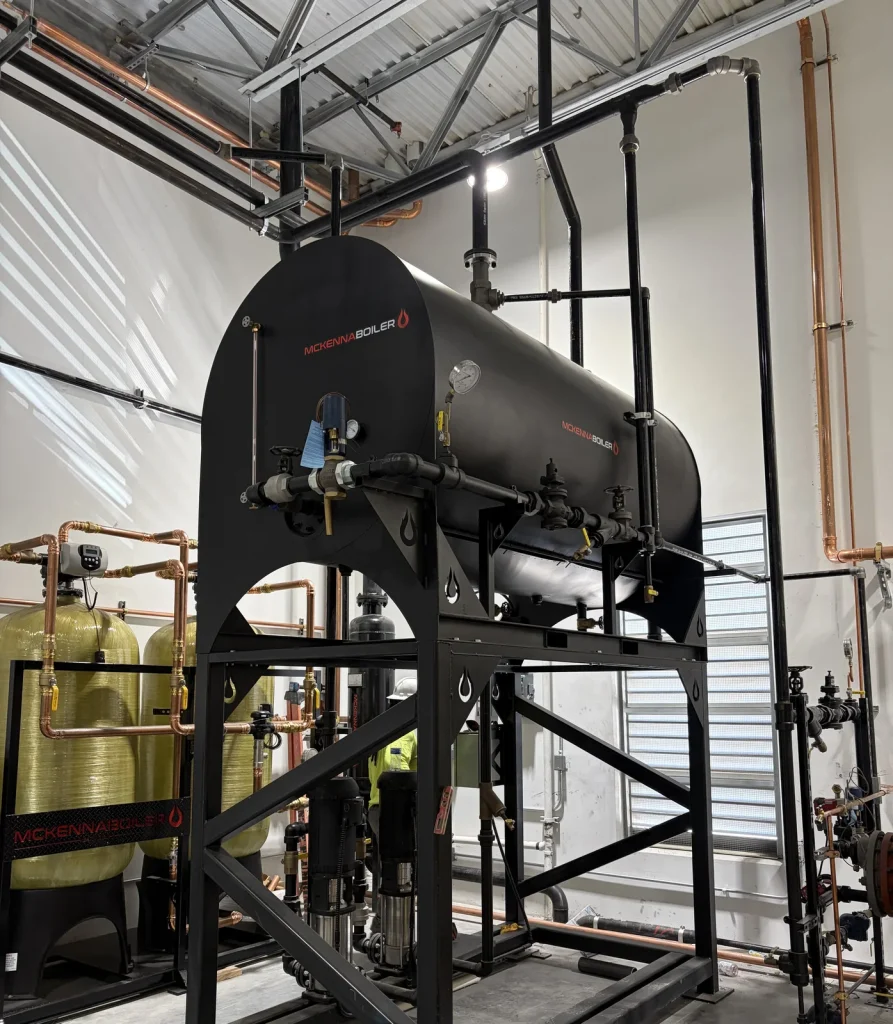
A steam boiler’s performance comes down to an energy balance: the heat released by the fuel either goes into the water and steam or leaves through the stack, the shell, and the blowdown. McKenna Boiler Works, Inc. builds steam boilers in California, and the same few pieces of physics, latent heat, saturation pressure, and combustion losses, explain how much fuel any steam boiler burns. This post works through steam boiler physics with numbers a plant engineer can check against steam tables.
Where does the energy in a steam boiler go?
For a boiler in steady operation, the heat absorbed equals the steam flow times the rise in enthalpy from feedwater to steam:
Heat absorbed (Btu/hr) = steam flow (lb/hr) × (enthalpy of steam − enthalpy of feedwater)
Fuel input is that figure divided by the boiler’s fuel-to-steam efficiency. A worked example: 10,000 lb/hr of saturated steam at 100 psig has an enthalpy of about 1,190 Btu/lb. Feedwater at 220°F carries about 188 Btu/lb. The boiler absorbs 10,000 × 1,002, or about 10.0 million Btu/hr, which is roughly 300 boiler horsepower (one boiler horsepower is 33,475 Btu/hr). At 82% efficiency, the burner must fire about 12.2 million Btu/hr. The other 2.2 million Btu/hr leaves as losses.
The same equation shows why feedwater temperature matters: every degree of heat already in the feedwater is heat the burner does not have to supply. Hot condensate return and a feedwater economizer both work by raising that second enthalpy term.
Why does steam carry so much heat, and how does pressure change it?
Most of the heat in steam is latent heat, the energy needed to turn water at its boiling point into vapor without raising its temperature. Steam gives that heat back when it condenses at the point of use, at a constant temperature set by its pressure. That is why steam is used for process heating, sterilization, and jacketed kettles.
| Steam pressure (psig) | Saturation temperature (°F) | Latent heat (Btu/lb) |
|---|---|---|
| 0 | 212 | 970 |
| 15 | 250 | 945 |
| 100 | 338 | 881 |
| 150 | 366 | 857 |
Two practical points follow. Higher pressure raises the condensing temperature, which drives heat into a process faster, but each pound carries slightly less latent heat. And steam at higher pressure is denser, so plants often generate at a higher pressure, distribute in smaller pipe, and reduce pressure near the load.
The water in the boiler also stores energy. In a firetube boiler with a large water volume, a sudden steam draw drops the pressure, and some of the hot water flashes to steam, which carries the boiler through the swing. The same flashing makes the water level swell during a fast draw, which is why level controls and low water cutoffs must be set for the boiler’s real behavior.
What decides combustion efficiency?
The largest loss in a gas-fired boiler is the stack. Two things set it:
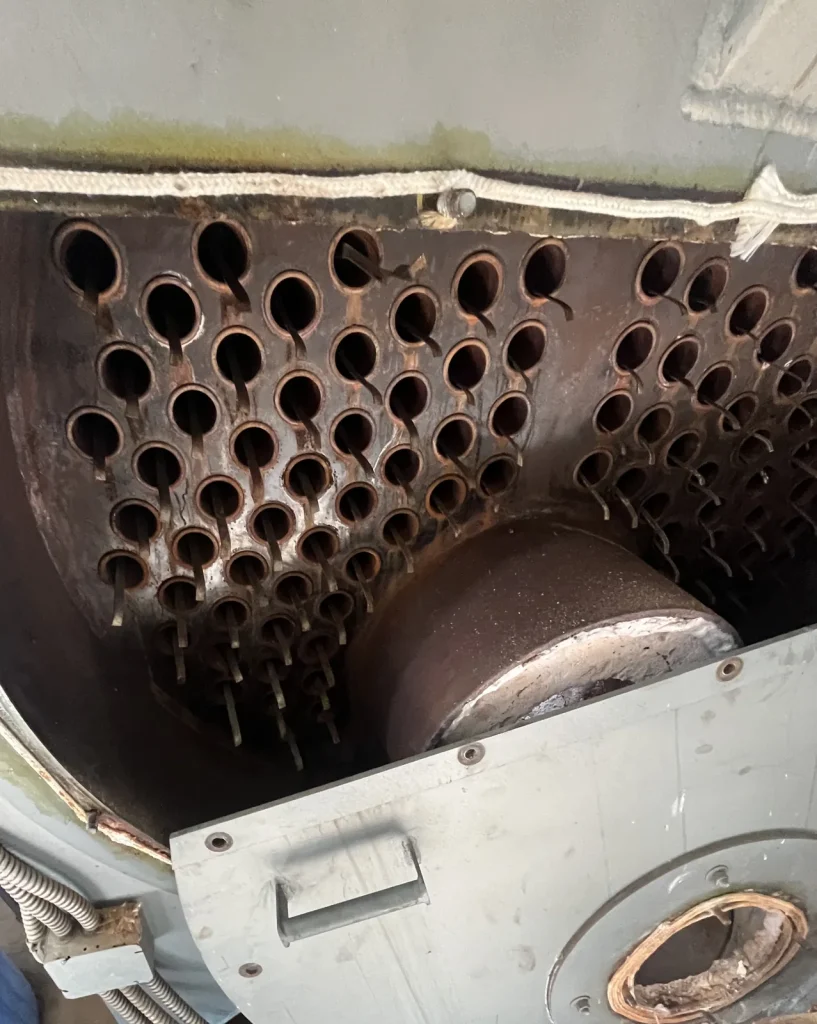
- Stack temperature. Hot flue gas carries heat away. A common U.S. Department of Energy rule of thumb (Steam Tip Sheet #3) is about 1% efficiency gained for every 40°F the stack temperature is lowered. A stack temperature that rises over months at the same firing rate points to soot on the fire side or scale on the water side.
- Excess air. Burners need some air beyond the chemical minimum to burn the fuel completely. Every extra pound of air is heated and thrown out the stack. Measured as oxygen in the flue gas, excess air is held to the burner manufacturer’s target by combustion tuning, and an O2 trim system holds it there as air temperature and fuel change. Too little air makes carbon monoxide and soot, which is a safety and emissions problem.
Natural gas is mostly methane, and burning its hydrogen makes water vapor. The latent heat in that vapor leaves with the flue gas unless the gas is cooled below its dew point, around 130°F. A steam boiler’s water is at or above 212°F, so it cannot condense its own flue gas. Condensing boilers are hot water boilers that need return water below about 130°F, and a steam plant can only recover that heat with a condensing economizer that feeds a separate low-temperature water load.
What other losses should an engineer account for?
- Blowdown. Blowdown water leaves at boiler saturation temperature, 338°F at 100 psig. It is needed to hold dissolved solids within the boiler manufacturer’s limits and the program the water treatment company sets; more than that wastes fuel and water, and less than that risks carryover and scale.
- Radiation and convection from the shell. Roughly constant in Btu/hr, so it is a larger share of input at low fire.
- Cycling. Each burner start has a pre-purge and each stop a post-purge that push air through the hot boiler and cool it. A burner that short cycles at light load loses heat with every cycle.
How do firetube and water-tube designs differ physically?
In a firetube boiler, the hot gas runs inside tubes surrounded by water in a large shell. The stress in a cylindrical shell rises with diameter and pressure (hoop stress equals pressure times diameter divided by twice the wall thickness), so large shells limit firetube boilers to moderate pressures. In exchange, their large water volume rides through load swings well. In a water-tube boiler, water runs inside small tubes, which can hold high pressures with thin walls; the small water volume comes up to pressure faster but reacts more sharply to swings. Both are protected by the same devices: safety valves, low water cutoffs, and a flame safeguard.
What to check
- Log stack temperature and flue gas O2 at high and low fire, and compare with the readings recorded right after the last tuning. Rising stack temperature at the same firing rate means cleaning or a water side inspection is due.
- Log feedwater tank temperature. A drop often means less condensate is coming back.
- Check blowdown against the boiler manufacturer’s manual and your water treatment company’s instructions, and ask the water treatment company to confirm the conductivity limit.
- Count burner cycles per hour at light load. Frequent cycling points to a need for more turndown, a smaller boiler, or better sequencing.
- Look for uninsulated valves and fittings on hot lines.
- Test safety controls only as the manufacturer directs, with lockout/tagout and site procedures followed. If a low water cutoff or flame safeguard does not trip during a test, shut the burner off manually and call for service.
Common questions
What is the difference between combustion efficiency and boiler efficiency?
Combustion efficiency counts only the stack loss, calculated from stack temperature and flue gas O2. Fuel-to-steam efficiency also counts shell losses and is the number that sets fuel use. A combustion analyzer reading is a quick check, while fuel-to-steam efficiency needs fuel and steam flow measurement.
Why can’t a steam boiler be a condensing boiler?
Flue gas from natural gas condenses at around 130°F, and steam boiler water is at 212°F or hotter, so the gas never gets cold enough inside the boiler. A condensing economizer in the stack can recover some of that heat if it heats a cold water stream such as makeup water.
How much steam does one boiler horsepower make?
One boiler horsepower is 33,475 Btu/hr, which is 34.5 lb/hr of steam from and at 212°F. At real operating pressures and feedwater temperatures the steam output per horsepower is somewhat lower, so size from the actual enthalpy rise.
Why does stack temperature rise over time?
Soot on the fire side or scale on the water side insulates the tubes, so less heat reaches the water and more leaves in the flue gas. Poor combustion tuning and overfiring can also raise it. Comparing readings at the same firing rate tells you which way it is trending.
Does running at higher steam pressure waste fuel?
Slightly. The steam itself carries about the same total heat, but the boiler runs hotter, so stack temperature and shell losses rise a little, and leaks and blowdown at higher pressure lose more. Run at the lowest pressure the loads actually need.
McKenna Boiler Works, Inc. builds firetube, firebox, and vertical steam boilers in California and services and repairs other brands. McKenna installs, sets up, and tunes burners and controls from any manufacturer, and can recommend Limpsfield, Autoflame, or Power Flame. To bring stack temperature and excess air back to target, see combustion tuning, size a new boiler with the boiler sizing calculator, or call (323) 987-1816.