The main commercial boiler types are firetube, firebox, vertical, water-tube, and condensing, and the right one for a building or plant depends first on whether the load needs steam or hot water, then on pressure, load size and swings, and the room it has to fit. McKenna Boiler Works, Inc. builds firetube, firebox, and vertical boilers in California, standard or custom-designed to fit a specific room. This guide explains how each type works and which codes and controls come with it.
Steam or hot water: which does the load need?
This is the first decision, and it shapes the rest of the plant.
- Steam carries a large amount of latent heat per pound and gives it up at a fixed temperature as it condenses. It suits process heating, sterilization, humidification, jacketed kettles, laundries, and long distribution runs. A steam plant needs a feedwater system, condensate return, steam traps, blowdown, and a blowdown tank or separator.
- Hot water suits building heat and domestic hot water. The system is a closed loop with circulating pumps, an expansion tank, and air separation. Makeup water is small, so water treatment is simpler, and low return temperatures open the door to condensing boilers.
Many facilities have both: steam for process loads, and hot water made from steam through a heat exchanger or from separate hot water boilers.
What types of commercial boilers are there?
| Type | How it is built | Typical use | Things to know |
|---|---|---|---|
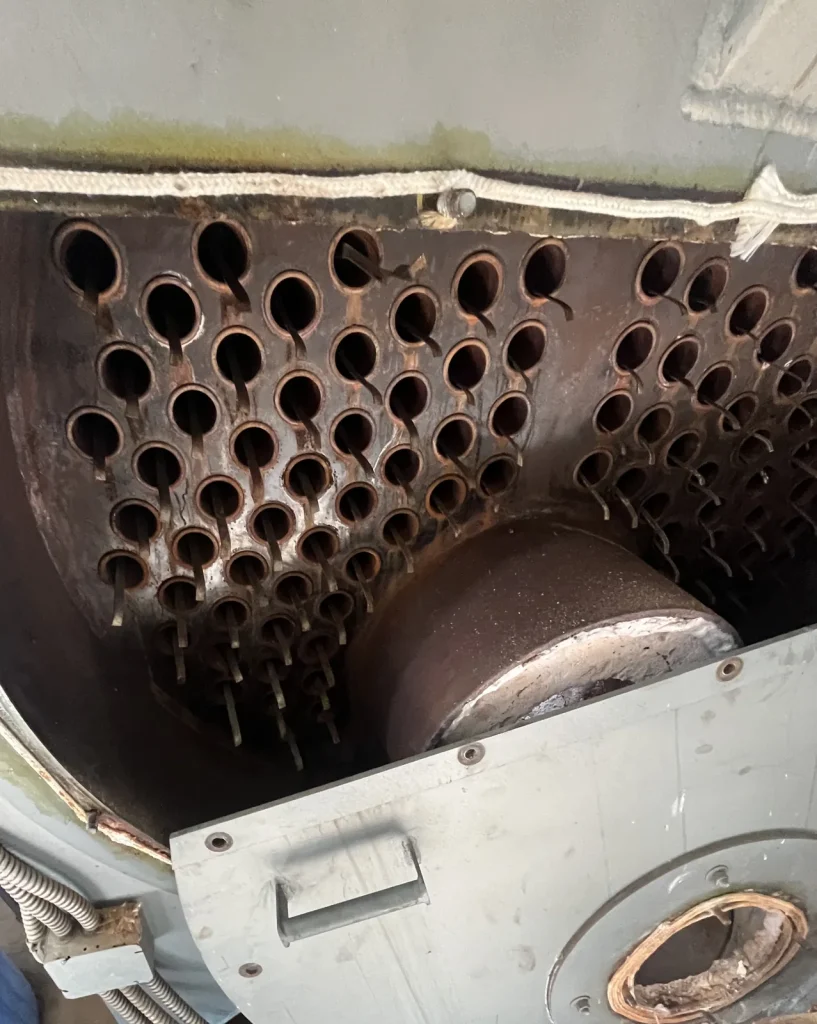
| Firetube (Scotch type) | Round furnace inside a water-filled shell; hot gas makes two to four passes through tubes | Process steam and building heat in plants, hospitals, laundries, food plants | Large water volume rides through load swings; slower to come up from cold |
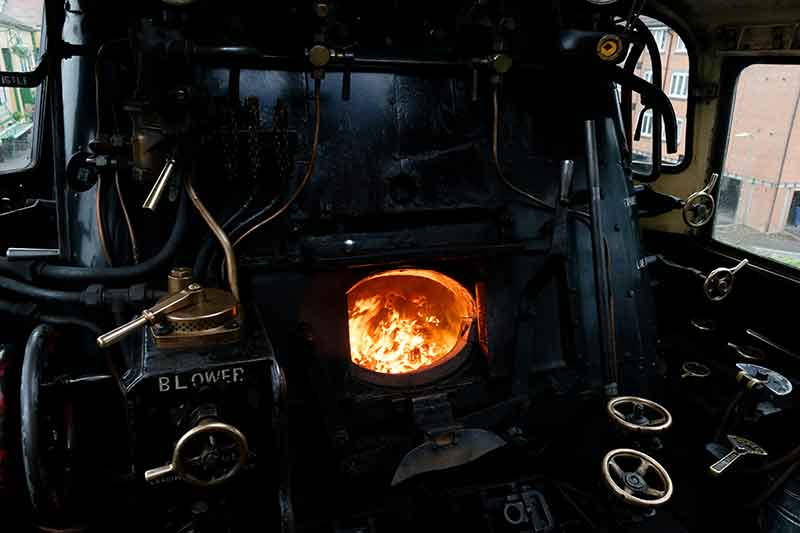
| Firebox | Rectangular firebox surrounded by water legs, with tubes above | Low and medium pressure steam and hot water where a compact, rugged boiler fits | Descended from the locomotive boiler; easy access for inspection |
| Vertical | Upright shell with vertical tubes | Small loads and tight rooms where floor space is short | Small footprint; check headroom for tube access |
| Water-tube | Water inside tubes, hot gas around them | Very high pressures and large steam flows | Small water volume responds fast but needs tighter water and level control |
| Condensing | Heat exchanger cools flue gas below its dew point | Low-temperature hot water heating loops | Hot water only; needs return water below about 130°F and a condensate drain |
Electric boilers have no on-site combustion emissions and can suit small loads, but operating cost depends on local power rates and the electrical service the building can supply.
Which codes and permits apply?
Pressure and temperature decide the construction code and the state rules:
- ASME Section I (power boilers): steam above 15 psig, or hot water above 160 psig or 250°F. In California, steam power boilers need a Cal/OSHA permit to operate and periodic inspections under the Boiler and Fired Pressure Vessel Safety Orders; 8 CCR 771 exempts some categories, including miniature and high-temperature water boilers, from annual inspection and the permit, under its conditions.
- ASME Section IV (heating boilers): steam at 15 psig or less, and hot water at 160 psig and 250°F or less. Under 8 CCR 771, low-pressure boilers are not subject to annual inspection or a permit to operate, but they must still meet the Safety Orders and keep their automatic controls in working order.
- Controls: ASME CSD-1 covers controls and safety devices on automatically fired boilers under 12.5 million Btu/hr input. NFPA 85 covers boilers at 12.5 million Btu/hr and above.
- Emissions: the local air district sets the burner’s NOx limit and permit. Examples are South Coast AQMD Rules 1146, 1146.1, and 1146.2, San Joaquin Valley APCD Rules 4306 and 4320, and Bay Area AQMD Regulation 9, Rule 7. The limit depends on the district and the burner’s input.
What is on a commercial boiler, and what does each part do?
- Burner and combustion controls. Mix fuel and air in the right ratio across the firing range. Turndown, the ratio of maximum to minimum firing rate, decides how well the boiler follows light loads without cycling.
- Flame safeguard. Runs the purge, proves the flame, and shuts the fuel off on flame failure.
- Operating and limit controls. A pressure control on steam boilers or a temperature control on hot water boilers runs the burner; a separate high limit shuts it off if the operating control fails.
- Low water cutoff and gauge glass. The cutoff shuts the burner off before heating surfaces are uncovered. The glass lets the operator see the level.
- Safety or relief valve. Sized to relieve the boiler’s full output at its set pressure.
- Feedwater system (steam) or expansion tank and air separator (hot water).
How do you size a commercial boiler?
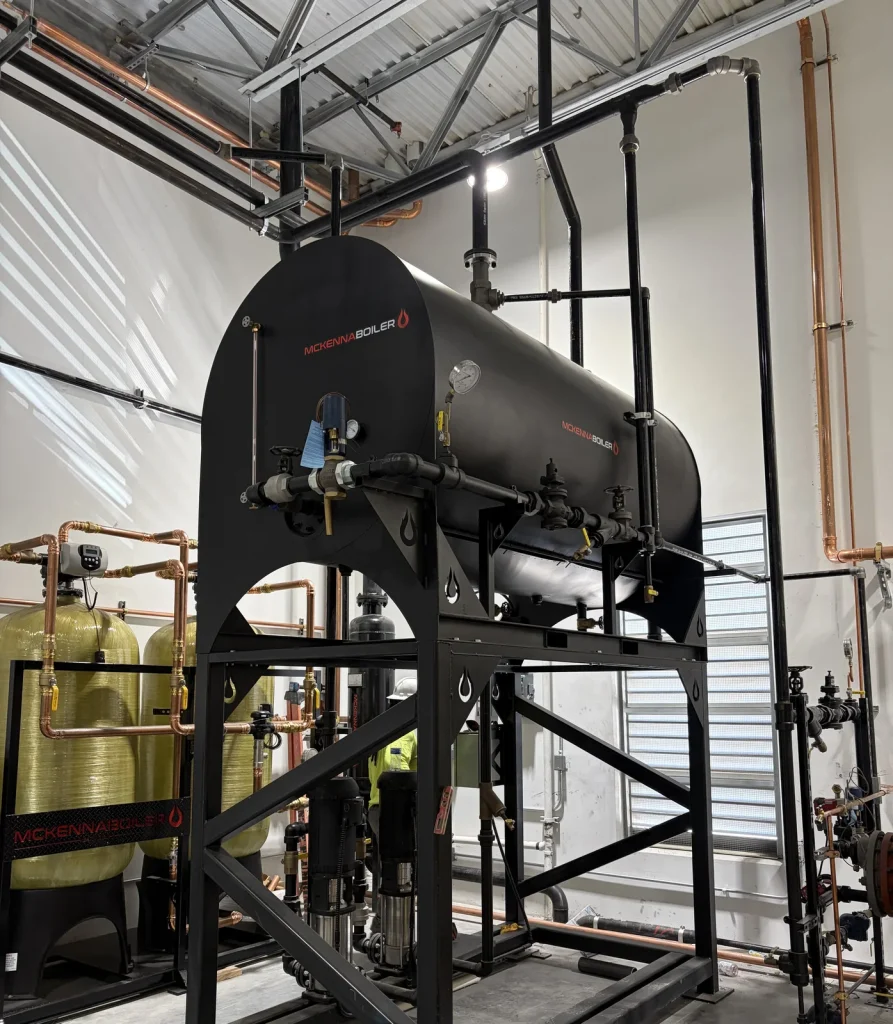
Start with the real load: peak steam flow in lb/hr or heat demand in Btu/hr, the pressure or temperature the loads need, and the lowest load the plant runs at. A boiler sized only for peak can cycle all summer. Two or three smaller boilers, or a burner with more turndown, often follow the load better, and they give redundancy. The boiler sizing calculator gives a starting point. The room matters too: door and aisle widths, headroom, tube pull space, stack routing, and combustion air openings. McKenna builds firetube, firebox, and vertical boilers in standard sizes or custom-designed to a customer’s specifications and footprint.
What to gather before choosing a boiler
- Load data: peak and minimum steam or hot water demand, and how fast it swings.
- Required pressure or temperature at each load.
- Fuel available, gas supply pressure, and the air district that will permit the burner.
- The existing boiler’s data plate, ASME data report, and Cal/OSHA permit if it is a replacement.
- Room drawings or measurements, including access routes for delivery.
- Condensate return percentage and a water analysis from the site’s water treatment company.
- Whether the plant needs a standby boiler to carry the load during service.
On an existing boiler, any test of a low water cutoff or flame safeguard must follow the manufacturer’s instructions, lockout/tagout, and site procedures. If a control does not trip during a test, shut the burner off manually and call for service.
Common questions
What is the difference between a firetube and a water-tube boiler?
In a firetube boiler, hot gas passes through tubes surrounded by water. In a water-tube boiler, water passes through tubes surrounded by hot gas. Firetube boilers hold more water and handle load swings well at moderate pressures, while water-tube boilers handle very high pressures and large steam flows.
Can a condensing boiler make steam?
No. Condensing works only when the water entering the boiler is cold enough, below about 130°F, to cool the flue gas below its dew point. Steam boiler water is always at 212°F or hotter.
Does a low-pressure boiler need a Cal/OSHA permit?
Under 8 CCR 771, low-pressure boilers are not subject to annual inspection or a permit to operate. They must still meet the Safety Orders and keep their automatic controls working, and they still need annual service.
What does boiler horsepower mean?
One boiler horsepower is 33,475 Btu/hr of output, the heat needed to evaporate 34.5 lb/hr of water from and at 212°F. It is the standard rating for firetube boilers.
Should I install one large boiler or several smaller ones?
Several smaller boilers usually follow a varying load with less cycling and let one boiler be serviced while the others carry the load. One large boiler costs less to install and takes less room. The right answer depends on the load profile and how critical the steam or heat is.
McKenna designs, builds, and installs turnkey boiler systems, engineered and built in California, and services and repairs other brands. To plan a new boiler room or a replacement, see boiler installation or call (323) 987-1816.