
Remote boiler monitoring sends live readings and alarms from a boiler’s controls to a building management system, a PC, or a phone, so staff can see trends such as a rising stack temperature or repeated lockouts before they turn into a shutdown. It watches; the boiler’s safety controls still do the protecting, at the boiler. McKenna Boiler Works, Inc. sets up and services remote monitoring on boiler rooms in California, and this post covers why plants monitor, what to watch, and what monitoring cannot do.
What is remote boiler monitoring?
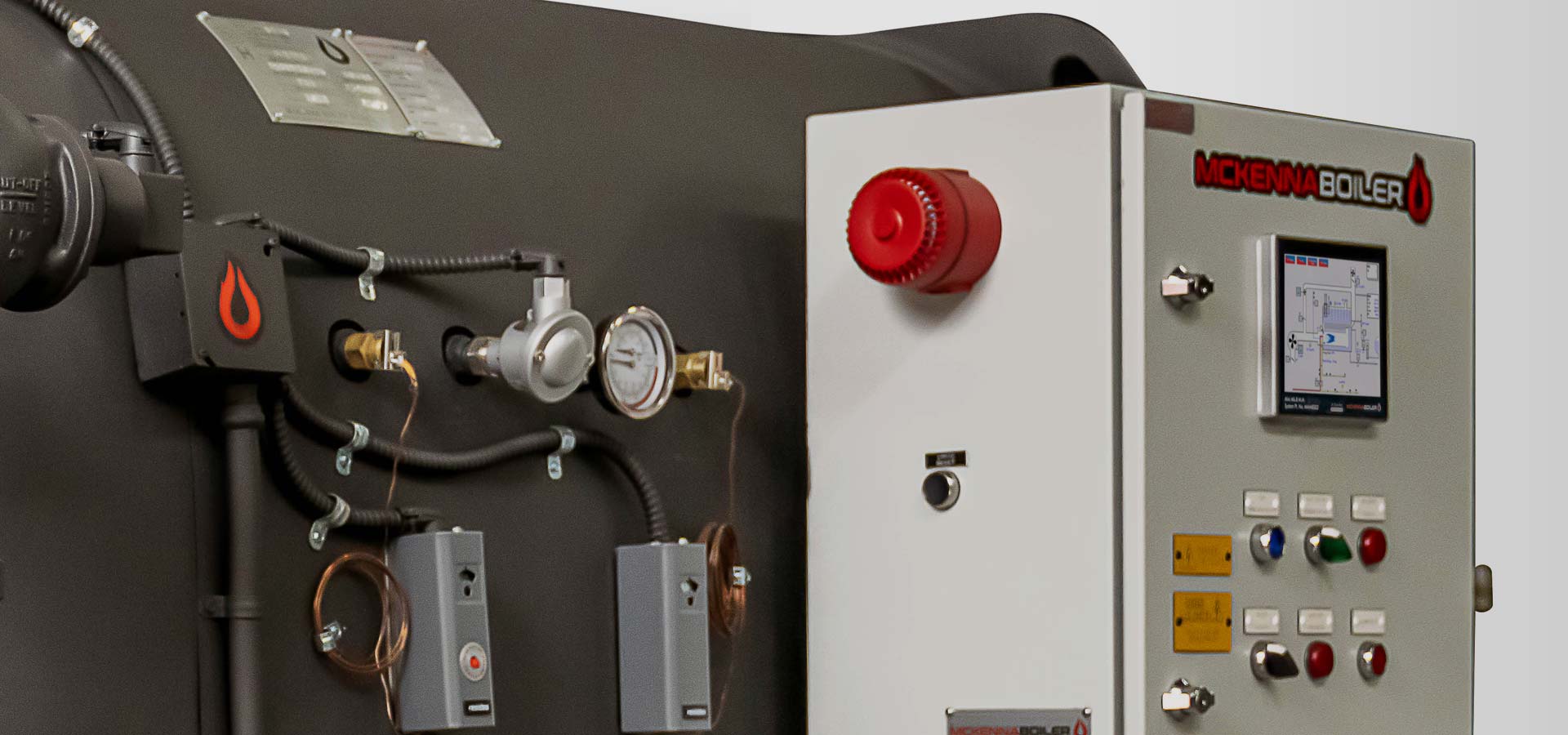
Modern burner management and combustion controls already measure most of what matters: firing rate, steam pressure or water temperature, flue gas oxygen, stack temperature, burner status, and alarm and lockout history. Remote monitoring connects those controls to the outside through a gateway, usually over Modbus or BACnet to a building management system (BMS), or to a web or PC interface. Alarms can be sent by email or text to the people on call.
Three things it gives a plant:
- Visibility when nobody is in the boiler room. Many plants run boilers unattended for long periods.
- History. A logged trend shows a slow change that no single reading would reveal.
- Faster, better-informed service calls. A technician who can see the lockout code and the readings just before it arrives with the right parts and a likely cause.
What should you watch, and what does each trend mean?
| Reading | Trend that matters | Likely causes |
|---|---|---|
| Stack temperature | Rising over weeks at the same firing rate | Soot on the fire side, scale on the water side, a baffle out of place |
| Flue gas O2 | Drifting from the value set at the last tuning | Linkage or actuator wear, sensor drift, a change in combustion air or fuel |
| Flue gas CO (if measured) | Rising | Too little air, burner fouling; needs a technician promptly |
| Burner starts per hour | Many short cycles at light load | Not enough turndown, oversizing, poor sequencing, control setpoints too close |
| Steam pressure or water temperature | Swinging wider than normal | Load changes, control tuning, a boiler not keeping up |
| Low water alarms | Any, and especially repeats | Feed pump, feedwater valve, level control, or feedwater tank problems |
| Lockouts | Same code repeating | Flame signal, ignition, gas pressure, air proving; investigate at the boiler |
| Feedwater tank temperature and makeup flow | Tank cooler, makeup rising | Lost condensate from failed traps or leaks |
Set a baseline right after a combustion tuning, when the boiler is clean and on target. Every later reading is compared with that baseline at the same firing rate. A trend means more when it is compared at matching loads, so record the firing rate with every reading.
What can remote monitoring not do?
- It does not replace safety controls. Low water cutoffs, high limits, and the flame safeguard must stay wired at the boiler and work whether or not the network is up. Monitoring reports what they did.
- It should not be used to reset safety lockouts from afar. A lockout means a safety control stopped the boiler. Someone qualified should look at the boiler, find the cause, and reset it there, following the manufacturer’s instructions and site procedures.
- It does not see everything. A gauge glass that is plugged, a weeping safety valve, a refractory crack, or a gas smell will not show on a screen. Walk-throughs, gauge glass checks, low water cutoff tests, and inspections still need people in the room.
- It does not replace the water treatment program. Conductivity may be logged if the boiler has automatic blowdown, but the water treatment company sets the program and tests the water.
How should a monitoring system be set up?
- Read-only by default. Give the BMS and remote users read access. Any remote write, such as changing a setpoint or enabling a boiler, should be a deliberate decision with the controls’ maker and the site’s engineer.
- Network separation. Keep boiler controls on their own network segment behind a firewall, with remote access through a secure, logged connection.
- Alarms that reach a person. Send each alarm to someone who will answer at 2 a.m., and set an escalation if nobody acknowledges it.
- Sensible thresholds. Too many nuisance alarms teach people to ignore them. Start with lockouts, low water, and high stack temperature.
On boilers with Autoflame Mk8 MM controls, the Autoflame Mk8 DTI is the usual gateway for this data. McKenna is a factory-authorized Autoflame Tech Center, and installs, sets up, and tunes burners and controls from any manufacturer. New McKenna boilers come with Autoflame controls as a standard option. For older boilers, a controls upgrade can add the data points that monitoring needs.
What to do with the data
- Record a baseline of stack temperature, O2, and firing rate after each tuning.
- Review trends weekly; compare stack temperature and O2 at the same firing rate.
- Investigate any repeating lockout code at the boiler before resetting.
- Treat every low water alarm as real until someone has checked the gauge glass, feed pump, and level control.
- Count burner starts per hour on light-load days; frequent cycling is worth fixing.
- Share the trends with your service provider before each scheduled visit.
- Keep testing low water cutoffs and the flame safeguard by hand on the manufacturer’s schedule, following lockout/tagout and site procedures. If a control does not trip, shut the burner off manually and call for service.
Common questions
Can I run my boiler unattended if it has remote monitoring?
Whether a boiler can run unattended depends on its controls, your jurisdiction’s rules, your insurer, and your site procedures. Remote monitoring helps staff respond faster, but it does not change those requirements. Check them before reducing attendance.
What protocol do boiler controls use to talk to a BMS?
Modbus (over RS485, RS422, or Ethernet) and BACnet are the most common. Many controls support one directly, and others use a gateway. Confirm which points are available before designing the BMS screens.
Is it safe to reset a boiler lockout remotely?
A lockout is a safety control telling you something is wrong. Find the cause at the boiler before resetting, and follow the manufacturer’s instructions and your site’s procedures.
What is the most useful single reading to trend?
Stack temperature at a known firing rate. A steady rise points to fouling on the fire side or scale on the water side, both of which waste fuel and, on the water side, can damage tubes.
Does remote monitoring cut fuel use by itself?
No. It shows where fuel is being wasted, such as drifting O2 or short cycling. The savings come from acting on what it shows: tuning, cleaning, or control changes.
McKenna Boiler Works, Inc. sets up monitoring on new McKenna boilers and on other brands, and services the boilers behind the data. To add monitoring to your boiler room, see remote monitoring, or call (323) 987-1816; a live person answers 24/7.