

Yes, it can: a boiler room that is short of air, or pulled into negative pressure by exhaust fans, makes the burner run rich, which shows up as soot, carbon monoxide, flame instability, lockouts, and poor draft. A common figure is about 10 cfm of outside air per boiler horsepower through permanent openings. That number is boiler manufacturer guidance, not a code value, so follow the California Mechanical Code and the boiler and burner manufacturer’s instructions for your installation. McKenna Boiler Works, Inc. installs and services boilers and burners in California, and this post explains boiler room combustion air: how much is needed, where it should come in, and how to check it.
Why does the burner need so much air?
Burning natural gas completely takes roughly 10 cubic feet of air for every cubic foot of gas, plus the excess air the burner manufacturer specifies to make sure every bit of fuel finds oxygen. A burner is tuned to a set air-fuel ratio, checked by measuring oxygen and carbon monoxide in the flue gas. If the room cannot supply that air, the fan moves less of it, the mixture goes rich, and CO rises quickly. Air density matters too: warmer air carries less oxygen per cubic foot, so on burners without O2 trim, the tuning shifts with the seasons.
The boiler room also needs ventilation air to carry away heat from the boiler, piping, and motors, and to keep controls and the burner’s air within their rated temperatures.
How much combustion air does a boiler room need?
The 10 cfm figure comes from boiler manufacturers. One widely used manufacturer guideline is 8 cfm per boiler horsepower for combustion plus 2 cfm for ventilation, a total of 10 cfm per boiler horsepower up to 1,000 feet of elevation, adding 3 percent for each additional 1,000 feet. The same guidance limits air velocity through the openings to 250 feet per minute from the floor to 7 feet up and 500 feet per minute above 7 feet, so incoming air does not chill people and equipment, and calls for at least 1 square foot of total opening.
| Boiler size | Air required at 10 cfm/BHP | Net free area at 250 fpm |
|---|---|---|
| 50 BHP | 500 cfm | 2.0 sq ft (288 sq in) |
| 100 BHP | 1,000 cfm | 4.0 sq ft (576 sq in) |
| 250 BHP | 2,500 cfm | 10.0 sq ft (1,440 sq in) |
| 500 BHP | 5,000 cfm | 20.0 sq ft (2,880 sq in) |
That works out to roughly 6 square inches of net free area per boiler horsepower. “Net free area” is the open area left after louvers and screens: a louver or bird screen blocks part of the opening, so size the opening from the louver manufacturer’s free area rating. Add the air for every fuel-burning appliance in the room, including water heaters. These are manufacturer numbers. The California Mechanical Code, Chapter 7 (Combustion Air), sends appliances with power burners, which includes most packaged industrial boilers, to the manufacturer’s instructions for combustion, ventilation, and dilution air (Section 701.1.1). A natural draft appliance in the same room, such as an atmospheric water heater, falls under the code’s own sizing methods, which use different numbers and place openings near the top and bottom of the room. Follow the CMC and the boiler and burner manufacturer’s instructions; where they differ, the engineer of record and the local building official decide.
Where should the air openings go?
- At least two permanent openings, commonly on opposite sides of the room, so air mixes and the room stays near outdoor pressure.
- Low inlets, generally within 7 feet of the floor, so incoming air reaches the burner without stratifying near the ceiling. Do not aim cold air directly at the burner, controls, or water lines.
- Clean air. Keep inlets away from exhaust outlets, loading docks with idling trucks, and stored chemicals. Halogenated compounds such as chlorine from pool chemicals, solvents, and some refrigerants form acids in the flame that corrode burners and boilers.
- Motorized louvers must be interlocked so the burner cannot fire until the louver is proven open.
What causes negative pressure, and how do you test for it?
A boiler room should run at or very close to outdoor pressure. Exhaust fans, kitchen hoods, dryers, and process exhausts in or near the boiler room pull air out, and if the openings cannot make it up, the room goes negative. Boiler manufacturers generally recommend against an exhaust fan in the boiler room for this reason. Symptoms include doors that are hard to open or slam, a flame that changes when a fan starts, flue gas spilling at a draft hood, soot, and CO alarms.
A simple check: with all boilers firing and every exhaust fan in the building that could affect the room running, open the outside door slightly. A strong rush of air into the room means it is under negative pressure. A technician can measure the pressure difference with a manometer and compare it with the burner manufacturer’s limit.
What to check
- Walk the combustion air openings monthly. Remove debris, leaves, and stored items, and never block openings to keep the room warm.
- Confirm motorized louvers open fully and their end switches prove open before the burner fires.
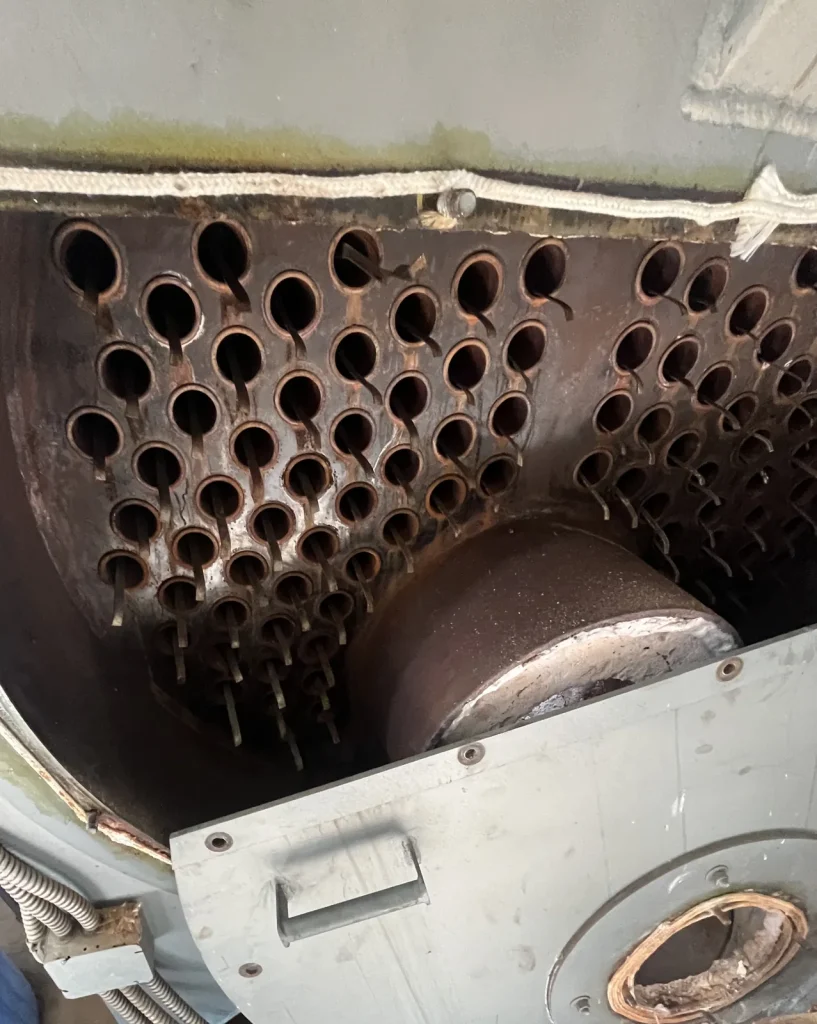
- Look for soot at the burner, flue connections, and stack, which points to poor combustion.
- Do the door test with boilers firing and exhaust fans running, and repeat it after any building change that adds exhaust.
- Keep a CO alarm in the boiler room and test it as the alarm manufacturer directs.
- If a CO alarm sounds or you smell gas, leave the room, follow the site’s emergency procedure, and call for service. Do not restart the burner until a qualified technician has found the cause.
- Have flue gas O2 and CO checked at every tuning, and after any change to the room’s air supply.
Common questions
How much combustion air does a 100 horsepower boiler need?
Using the common guide of 10 cfm per boiler horsepower, about 1,000 cfm. At 250 feet per minute that is about 4 square feet of net free opening. That is manufacturer guidance; the boiler and burner manufacturer’s instructions and the California Mechanical Code set the final number.
Can I put a screen or louver over the air opening?
Yes, to keep out debris and animals, but screens and louvers cut the open area. Size the opening on the net free area after the louver or screen, using the louver manufacturer’s rating. Avoid fine mesh, which clogs; the California Mechanical Code does not allow screens finer than 1/4 inch mesh.
Can I use a fan to bring in combustion air?
Mechanical supply air is allowed when designed for it, and the burner must be interlocked so it cannot fire unless the fan is proven running. Size and controls should be set by the engineer of record.
Why does my boiler make soot only in summer or only when the kitchen hood runs?
Hot air carries less oxygen, and a kitchen hood can pull the boiler room negative. Either one can starve a burner tuned under different conditions. Have the room’s air supply checked and the burner retuned, and consider O2 trim.
McKenna Boiler Works, Inc. builds and installs turnkey boiler systems in California, and services and repairs other brands. McKenna installs, sets up, and tunes burners and controls from any manufacturer, and can recommend Limpsfield, Autoflame, or Power Flame. For a combustion check of your boiler room, see combustion tuning; for a new boiler room, see boiler installation; or call (323) 987-1816.