

Boiler tuning, also called a combustion tune-up, sets the fuel-air ratio across the burner’s firing range so the boiler burns its fuel completely with as little excess air as is safe, while staying inside its air permit limits for NOx and CO. A technician measures flue gas O2, CO, NOx, and stack temperature with a calibrated combustion analyzer at several firing rates and adjusts the burner at each point. McKenna Boiler Works, Inc. tunes burners from any manufacturer and is a factory-authorized Autoflame Tech Center and Limpsfield Burner Tech Center.
Why does the fuel-air ratio matter?
Every pound of natural gas needs a fixed amount of air to burn completely. Burners run with some excess air above that amount, because no burner mixes fuel and air perfectly. The question is how much.
- Too little air leaves fuel unburned. CO rises, soot builds on the tubes, and in the worst case unburned gas collects in the furnace.
- Too much air wastes fuel. The extra air is heated from room temperature to stack temperature and carried out the stack.
A common rule of thumb from the U.S. Department of Energy is that boiler efficiency rises about 1 percent for each 15 percent cut in excess air, or for each 40°F drop in stack temperature. On natural gas, 3% O2 in the flue gas works out to roughly 15 percent excess air.
Settings drift. Linkages wear and slip, fans and air filters foul, and gas pressure changes. Air density changes too: combustion air at 40°F is about 10 percent denser than air at 90°F, so a burner with fixed settings runs leaner in winter and richer in summer. Ultra-low NOx burners have a narrower window between high NOx and high CO, so they drift out of compliance sooner.
What happens during a tune-up?
- Inspect the burner: air inlet and filter, fan wheel, linkage or actuators, ignition, flame scanner, and the gas train for leaks.
- Check gas pressure at the train at low and high fire against the burner manufacturer’s settings.
- Insert a calibrated analyzer probe in the stack at the test port.
- Fire the burner through its range. At each point, set fuel and air and record O2, CO, NOx, stack temperature, and draft or furnace pressure.
- Confirm the flame is stable at light-off and at every firing rate, and that the flame safeguard responds as it should.
- Set up O2 trim if the control has it, and leave a written report of the readings.
| Reading | What it tells you | Watch for |
|---|---|---|
| O2 | How much excess air the burner is running | Readings outside the burner manufacturer’s range at any firing rate |
| CO | Incomplete combustion | Rising CO from air shortage, poor mixing, or flame touching the furnace wall |
| NOx | Compliance with the air permit | Values near the limit after correction to 3% O2 |
| Stack temperature | Heat leaving the boiler unused | A rise over time at the same firing rate, which points to soot on the fire side or scale on the water side |
Linkage, parallel positioning, and O2 trim
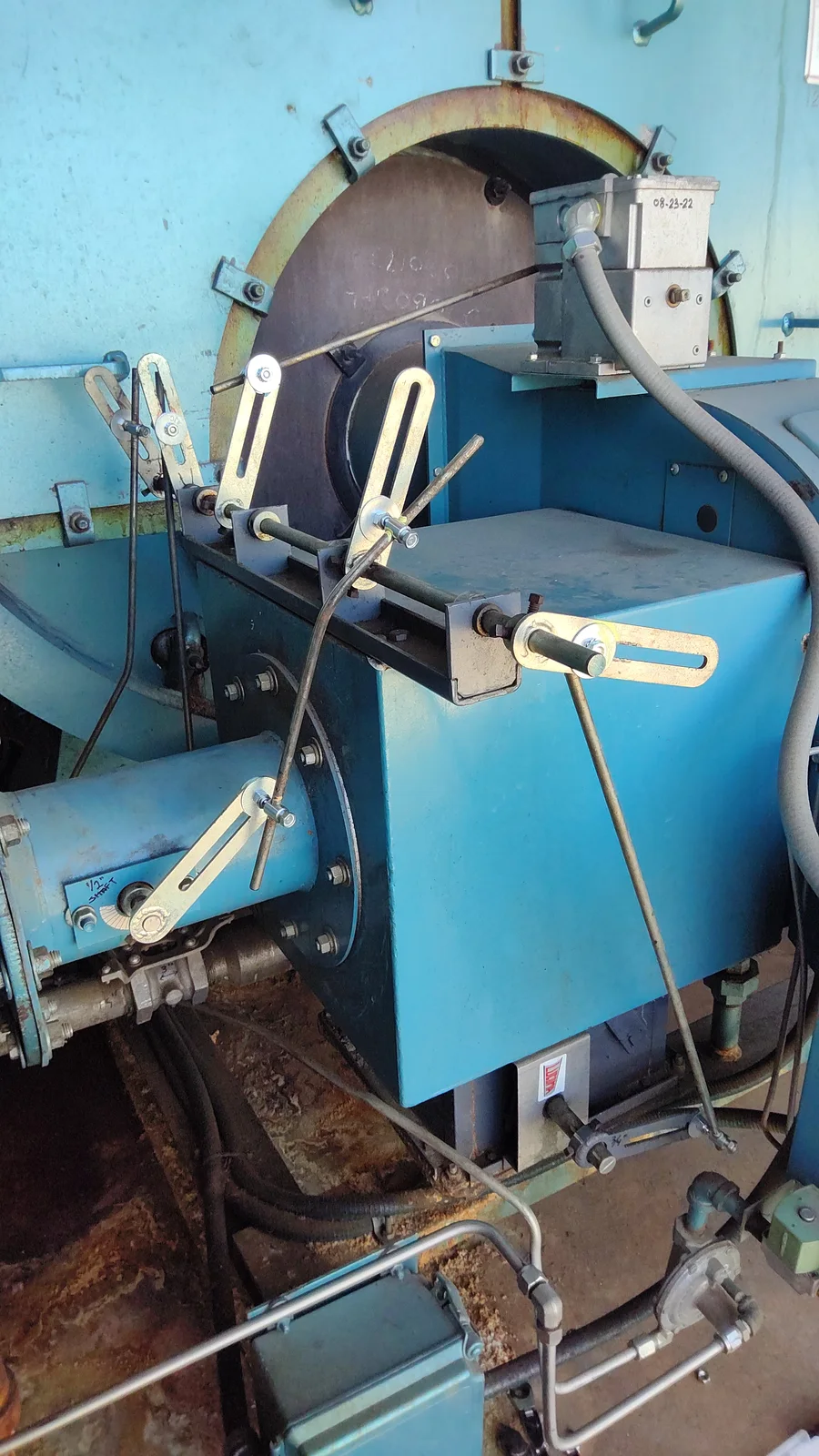
Older burners use single-point positioning: one actuator drives the fuel valve and air damper through a jackshaft and linkage. The ratio can be set well at a few points, but linkage play and wear mean it is only approximate between them, and it shifts as parts wear.
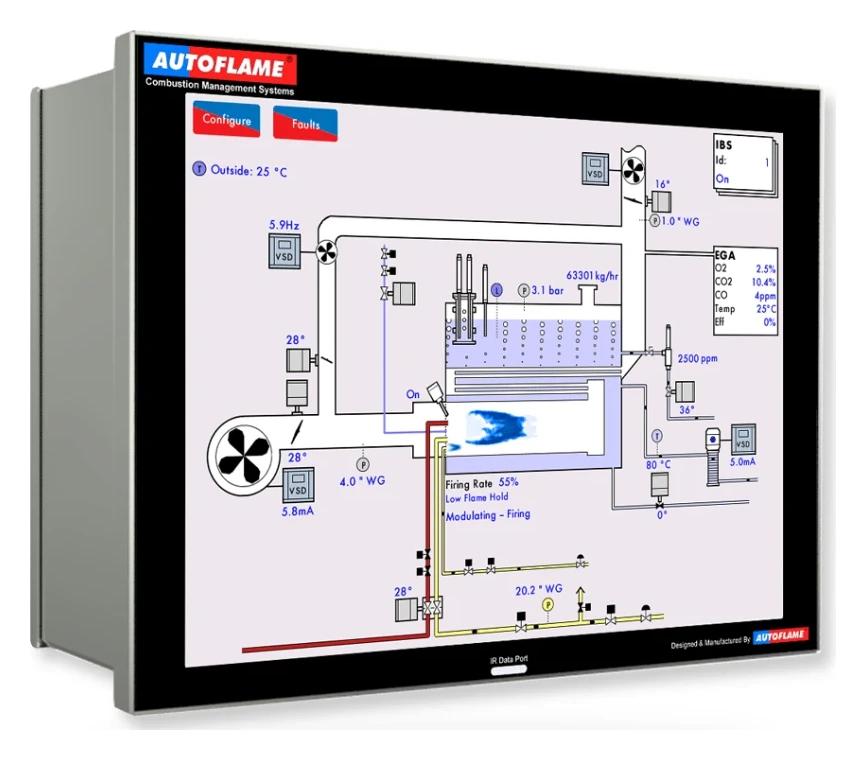
Parallel positioning uses a separate servo motor for the fuel valve and the air damper, and for FGR or a fan drive where fitted. The controller stores the fuel-air ratio point by point across the range and repeats it every time. Autoflame is one example, and new McKenna boilers come with Autoflame controls as a standard option.
O2 trim adds a flue gas oxygen sensor and adjusts air or fuel in real time to hold the O2 setpoint as air temperature, humidity, and gas quality change. It holds the tune between visits, and the burner still needs its regular tune-up. For older burners, a control upgrade to parallel positioning with O2 trim is often the larger long-term improvement.
How often should a boiler be tuned?
Tune at least once a year, and more often where your air district or permit requires it. In California, South Coast AQMD Rules 1146, 1146.1, and 1146.2, San Joaquin Valley APCD Rules 4306 and 4320 (with the tuning procedure in Rule 4304 for units that use it), and Bay Area AQMD Regulation 9, Rule 7 set NOx and CO limits, and most of them add periodic monitoring or tune-up requirements. Your permit lists the schedule for portable analyzer checks and source tests.
Also retune after burner or control repairs, after a fuel change, when the load range changes, and whenever readings drift between visits.
What to check between tunings
- Log stack temperature at a steady firing rate each day. A steady rise means the heating surfaces are fouling.
- Look at the flame through the sight port. A change in shape, color, or length, or flame touching the furnace wall, needs a technician.
- Watch for soot at the stack or rear door, combustion smells, or a CO alarm in the boiler room.
- Keep combustion air openings clear and burner air filters clean.
- Record gas pressure at the train in the log.
- Test safety controls on the schedule the manufacturer and ASME CSD-1 set. Some checks are daily, others monthly or annual. Leak test the safety shutoff valves on the valve manufacturer’s schedule, typically at least once a year.
- If a flame safeguard or limit does not shut the burner off during a test, shut the burner off manually and call for service. Do not run the boiler until it is fixed.
- Do not adjust linkage, cams, or controller settings yourself. Follow the manufacturer’s instructions, lockout/tagout, and your site’s procedures for burner work.
Common questions
Does a tune-up lower NOx?
A tune-up brings the burner back to the settings that meet its NOx and CO limits. On ultra-low NOx burners, small changes in O2 move NOx and CO noticeably, so a tune-up is often what keeps the boiler in compliance.
What O2 should my boiler run at?
It depends on the burner. Conventional forced draft burners commonly run in the low single digits of percent O2 at high fire, while lean premix ultra-low NOx burners run higher by design. Use the burner manufacturer’s settings and your permit limits.
Why did my stack temperature go up?
At the same firing rate, a rising stack temperature usually means soot on the fire side or scale on the water side. It can also mean the burner is overfiring or running too much excess air. Have the burner checked and the boiler opened at the next inspection.
Is a tune-up the same as a source test?
No. A tune-up adjusts the burner. A source test is a formal emissions test done to the air district’s procedures to show the boiler meets its permit limits.
Can O2 trim replace annual tuning?
No. O2 trim holds the O2 setpoint between tune-ups, but it relies on a good fuel-air curve and a working sensor. McKenna Boiler Works, Inc. checks the sensor and the curve during each tune-up.
To schedule a tune-up with analyzer readings and a written report, see combustion tuning or call (323) 987-1816.