



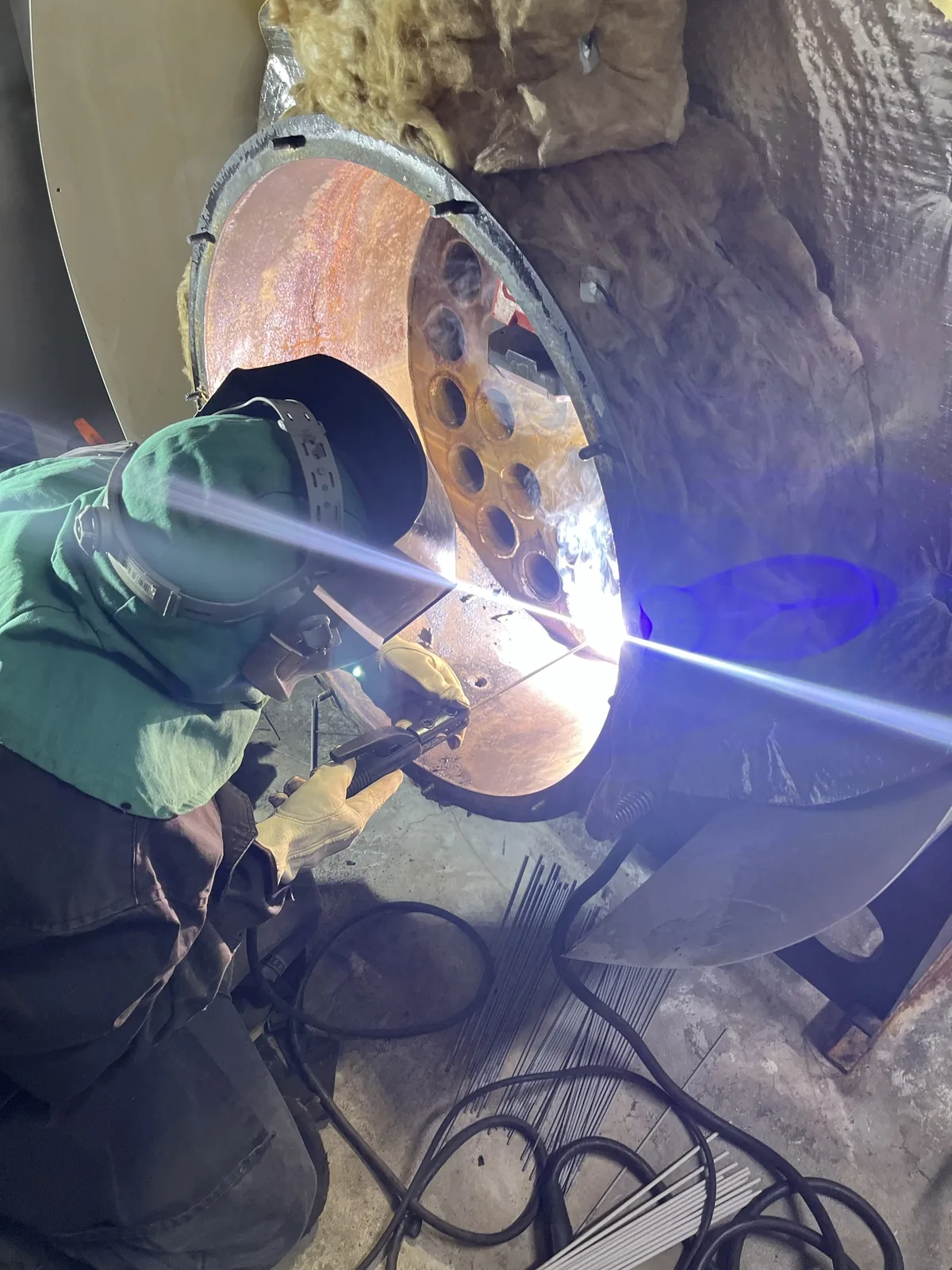
A boiler R stamp repair is welding or other code work on the pressure parts of a boiler or pressure vessel, done under the National Board Inspection Code (NBIC) by a company that holds a National Board R Certificate of Authorization. You typically need one when you weld on a shell, tubesheet, or furnace, replace seal-welded tubes, or repair a nozzle on a code-stamped boiler or vessel, though the exact rules depend on your jurisdiction. In most cases, replacing rolled and beaded tubes is not an R stamp repair; check with your Authorized Inspector. McKenna Boiler Works, Inc. holds National Board R Certificate No. 11037 and makes code repairs on boilers and pressure vessels from any manufacturer.
Is the work a repair or an alteration?
ASME Section I covers how power boilers are built, and ASME Section IV covers heating boilers. Once a boiler is in service, repairs and alterations follow the NBIC in jurisdictions that adopt it. NBIC Part 3 covers repairs and alterations.
A repair restores the boiler to a safe operating condition without changing its design. Replace a seal-welded tube, weld a corroded area back to thickness, or cut out and replace a cracked section, and the boiler still matches its original Manufacturer’s Data Report.
An alteration changes the design. Raising the maximum allowable working pressure (MAWP) or temperature, increasing heating surface or steaming capacity enough to need more relieving capacity, or adding an opening that needs reinforcement are all alterations. An alteration needs design calculations, and the paperwork is different.
The line between the two is not always obvious. A new nozzle can be a repair or an alteration depending on its size and whether it needs reinforcement. The Inspector, and in some cases the jurisdiction, makes that call, so ask before the job is scoped.
What work counts as a code repair?
If the work welds on a pressure-retaining part, or replaces one that is welded in place, treat it as a code repair until your inspector says otherwise. Common examples:
- Replacing seal-welded tubes, or a retube that involves welding on the tubesheet.
- Welded repairs to shells, tubesheets, and furnaces, such as building up pitted or corroded areas or replacing a cracked section.
- Nozzle work, such as replacing a corroded nozzle, repairing a nozzle weld, or replacing a flange on a pressure connection.
- Stay and staybolt replacement on firebox boilers.
- Weld repairs to code-stamped tanks and pressure vessels, such as air receivers and blowdown tanks.
Work that does not touch the pressure boundary, such as burner tuning, controls, refractory, gaskets, and cleaning, is maintenance. Some jurisdictions let certain routine repairs go ahead without prior inspector acceptance, but they still have to be documented. Check with your jurisdiction.
Who inspects a code repair?
Every code repair has a third party checking it. The Authorized Inspector (AI) holds a National Board commission and works for an Authorized Inspection Agency (AIA) or for the jurisdiction. Every R certificate holder must keep an inspection agreement with an AIA, and the inspector on a repair normally comes through that agreement. On a repair, the AI:
- Accepts the repair method before work starts.
- Checks that the welding procedures and welders are qualified, normally under ASME Section IX.
- Inspects the work in progress and the finished repair.
- Witnesses the pressure test when one is required.
- Signs the repair report.
The jurisdiction is the state or local authority that issues your permit to operate. In California, that is the Cal/OSHA Pressure Vessel Unit, and California’s boiler safety orders set their own repair rules, including which repairs need a qualified inspector’s approval before work starts. The jurisdiction sets its own rules on which repairs need notice, when an inspection is due after a repair, and how reports are filed. Rules differ from state to state, so confirm them before you plan the job.
How is a code repair documented?
When a repair is finished, the R certificate holder completes Form R-1, Report of Repair. It describes the boiler or vessel, the work done, the materials used, the pressure test, and who did and inspected the work. The certificate holder and the AI both sign it.
An alteration is documented on Form R-2, Report of Alteration. It covers both the design and the construction side of the change, and design calculations back up any new rating.
The repaired item is also marked. The certificate holder applies a stamping or nameplate near the original nameplate showing the R symbol, its certificate number, and the date. After an alteration that changes the rating, the new rating goes on the nameplate as well. Some jurisdictions waive the stamping for routine repairs, so ask yours.
Copies of the report go to the owner and the jurisdiction. If the boiler is registered with the National Board, the report can be registered too.
What records should the owner keep?
Keep a file for each boiler and pressure vessel for the life of the equipment. It should hold:
- The original Manufacturer’s Data Report and the National Board number, if the item is registered.
- Every R-1 and R-2 report, in date order.
- Inspection reports and the current permit to operate.
- Pressure test records and nondestructive examination (NDE) results, such as ultrasonic thickness readings.
- Water treatment logs from your water treatment company.
This file matters at the next inspection, when you sell or move the equipment, and when you have to decide whether to repair or replace. A boiler with a complete repair history is easier to evaluate than one with gaps.
How to plan a code repair
Most code repairs can be planned. Tube leaks, pitting, and cracked welds often show up at an annual inspection before they cause a forced outage. Planning around that gives you the most control over downtime.
- Schedule the shutdown. Pick a window when the load is lowest. Allow time to cool down, drain, and open the boiler, and for the inspection before the repair starts.
- Inspect first. An internal inspection with the boiler open sets the scope. Your water treatment company sets the chemical program and should be on site during the inspection to check and monitor the water side, because many pressure-part failures trace back to water chemistry.
- Get the repair method accepted. The R certificate holder writes up the repair, and the AI accepts it before any welding.
- Order materials. Replacement tubes, plate, and fittings have to meet the original code requirements. Material lead time can set the schedule.
- Plan for backup steam or heat. If you have no redundant boiler, a McKenna rental boiler can carry the load during the repair. Arrange it early so it is on site and connected before the shutdown.
- Test and close out. The AI witnesses the hydrostatic test if one is required, the R-1 is signed, and the boiler goes back in service.
If a failure forces an unplanned shutdown, the same steps apply on a shorter timeline. McKenna handles emergency boiler repairs for that situation.
Who can make a code repair?
Under the NBIC, code repairs are made by a company holding a National Board R Certificate of Authorization, and that company completes and signs Form R-1. Some jurisdictions accept other arrangements for certain work, so confirm what yours requires. Each certificate has a scope. McKenna’s covers metallic repairs and alterations at shop and field locations, so the work can be done at your plant or in McKenna’s shop in Oceanside, California.
McKenna also holds ASME S, H, M, and U certificates for building new boilers and pressure vessels, and maintains a written quality control manual for its code work. McKenna makes code repairs on boilers and pressure vessels from any manufacturer under its National Board R certificate, in Los Angeles and across California.
Schedule an R stamp repair
If an inspection turned up a code repair, or you are planning a shutdown, see McKenna’s National Board R stamp repair service. Call (323) 987-1816 to schedule the work.
Common questions
What is the difference between a National Board R certificate and an ASME certificate?
ASME certificates such as S, H, and U cover building new boilers and pressure vessels. The National Board R certificate covers repairs and alterations to equipment already in service, under the NBIC. Under the NBIC, code repairs are made by an R certificate holder, which completes and signs Form R-1.
Does replacing boiler tubes require an R stamp?
In most cases, replacing rolled and beaded tubes is not an R stamp repair; check with your Authorized Inspector before the work starts. When the tubes are seal welded, or the job involves welding on the tubesheet or other pressure parts, it is an R stamp repair: an R certificate holder does the work, an Authorized Inspector inspects it, and it is documented on Form R-1.
Who is the Authorized Inspector on a repair?
The Authorized Inspector holds a National Board commission and works for an Authorized Inspection Agency or for the jurisdiction. Every R certificate holder must keep an inspection agreement with an Authorized Inspection Agency, and the inspector on the repair normally comes through that agreement. Bring the inspector in early, because the repair method has to be accepted before work starts.
Can an R stamp repair be done on site?
Yes, if the certificate holder’s scope includes field work. McKenna’s National Board R certificate covers metallic repairs and alterations at shop and field locations. Smaller vessels and parts can also be repaired in the shop.
What paperwork should I get after a code repair?
Get a copy of the signed Form R-1, or Form R-2 for an alteration, plus any pressure test and NDE records. Check that the stamping or nameplate was applied near the original nameplate if your jurisdiction requires it. File everything with the boiler’s Manufacturer’s Data Report and inspection history.