
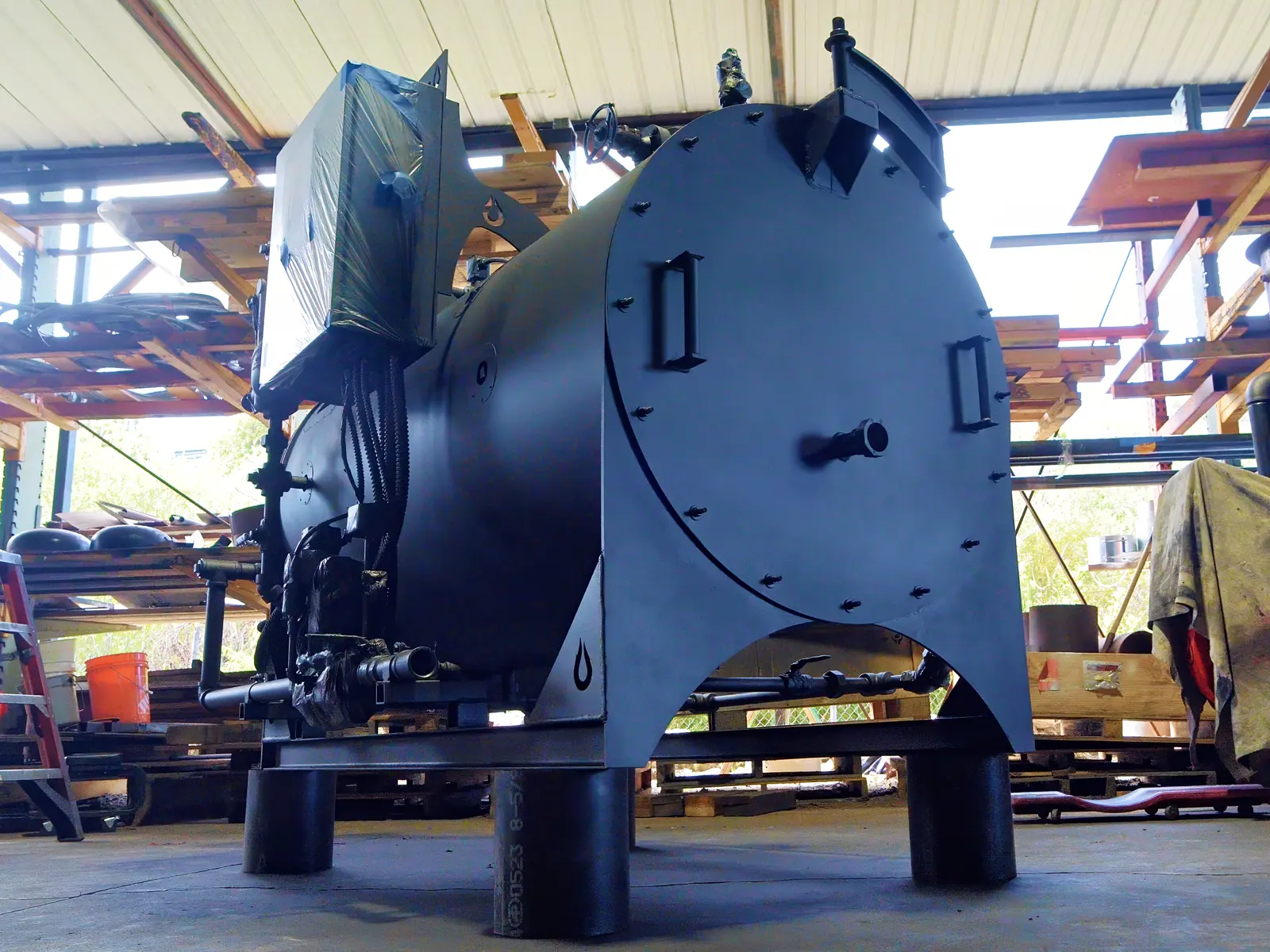
The right industrial boiler depends on four things: steam or hot water, the pressure or temperature you need, how the load swings, and the room you have to put it in. Firetube boilers fit most industrial and commercial steam and hot water loads; firebox and vertical boilers fit smaller loads and tight spaces; watertube boilers take over at very high pressures and capacities; condensing and electric boilers fit narrower cases. McKenna Boiler Works, Inc. builds firetube, firebox, and vertical boilers, and this comparison explains where each type fits and where it does not.
Which code applies: Section I or Section IV?
Before choosing a type, settle the pressure class, because it sets the construction code, the inspection rules, and often the operator requirements. ASME Section IV covers heating boilers: steam at 15 psig or less, and hot water at 160 psig or less and 250°F or less. Anything above those limits is a power boiler built to ASME Section I. In California, steam power boilers (above 15 psig) are inspected internally and externally at least once a year by Cal/OSHA or an insurance inspector under Labor Code 7682 and need a permit to operate; low-pressure boilers are exempt from the annual inspection and permit under 8 CCR 771 if their required controls are fitted and maintained.
Most process loads (sterilizers, jacketed kettles, presses, laundry ironers) need steam above 15 psig because they need temperature. Saturated steam at 15 psig is about 250°F; at 100 psig it is about 338°F; at 150 psig about 366°F. Building heat and many domestic hot water systems run at low pressure.
How do the main types compare?
| Type | How it works | Fits | Limits |
|---|---|---|---|
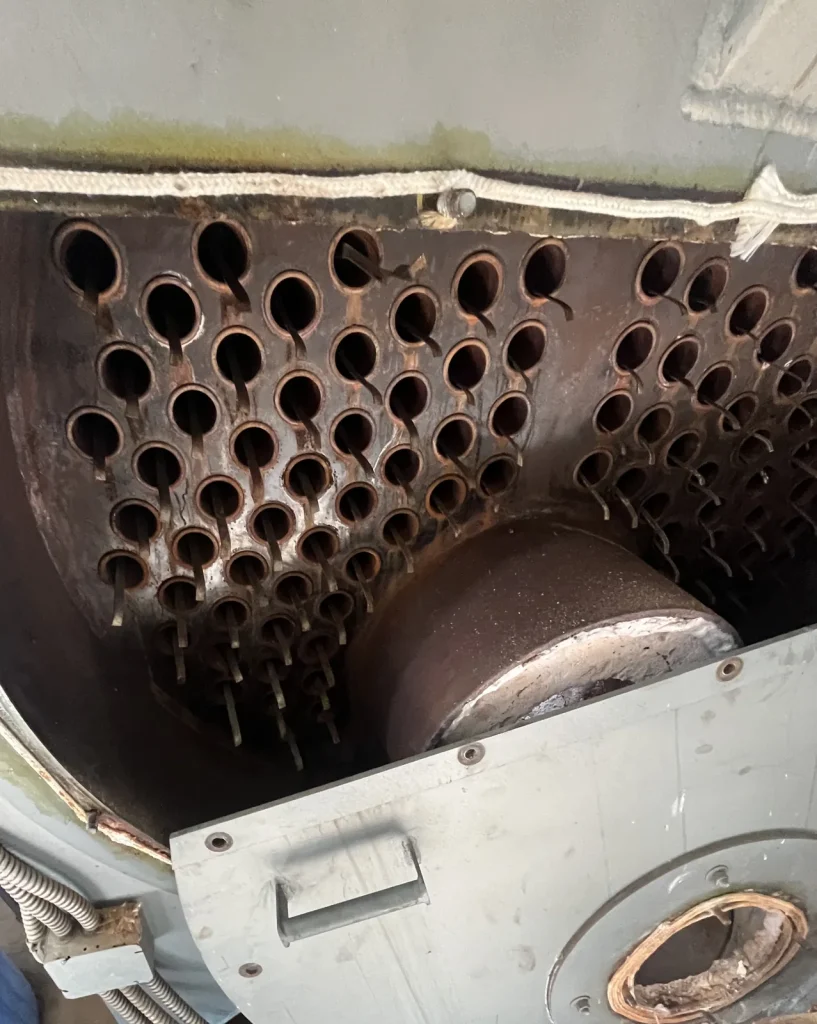
| Firetube | Combustion gas passes through a furnace tube and then through tubes surrounded by water in a horizontal shell | Low and high pressure steam and hot water; plants with load swings | Slower cold start; shell size limits practical pressure and capacity |
| Firebox | A firetube design with a box-shaped combustion chamber | Smaller steam and hot water loads, often low pressure heating | Smaller capacities than a full firetube |
| Vertical | Vertical shell with tubes or a furnace inside it, standing on end | Small loads, tight floor space, fast warm-up | Small sizes; less water stored for sudden loads |
| Watertube | Water flows inside tubes; combustion gas flows around them | Very high pressures, large capacities, superheated steam | Higher cost, tighter water chemistry, more complex to inspect |
| Condensing hot water | Flue gas cooled below its dew point to recover latent heat | Hot water systems with cool return water | Hot water only; gains disappear with hot return water; acidic condensate |
| Electric | Resistance elements or electrodes heat the water | Sites with ample electrical service and strict combustion limits | Operating cost depends on electric rates; needs large electrical service |
Why does water content matter for load swings?
A firetube boiler holds a large volume of water at saturation temperature. When a big load opens up, such as a batch sterilizer or a cook kettle coming on, pressure drops slightly and some of that stored water flashes to steam, carrying the load for the seconds to minutes it takes the burner to fire up. That stored energy is why firetube boilers ride swings well and hold steady pressure. A watertube or vertical boiler with less water reacts faster to burner changes but has less in reserve, so the controls have to respond more quickly to keep pressure from sagging and to keep water level from shrinking and swelling enough to trip a cutoff. The tradeoff is a slower cold start for the firetube: more water and more steel have to come up to temperature, and the warm-up has to be gradual to protect tube ends and refractory.
When do condensing and electric boilers make sense?
A condensing boiler recovers latent heat only when the flue gas cools below its dew point, which for natural gas is roughly 130°F. That needs return water well below that temperature, so condensing boilers suit low-temperature hot water heating. They do not make steam, and with hot return water they perform like a conventional boiler. Their condensate is acidic and usually needs neutralizing before it reaches the drain.
An electric boiler has no burner, no stack, and no on-site combustion emissions, which is the reason plants look at one under tight air district limits. Nearly all the electric energy ends up in the water, but the comparison that matters is cost per unit of heat delivered. One therm is 100,000 Btu, about 29.3 kWh, so compare the price of 29.3 kWh against the price of one therm divided by your gas boiler’s efficiency. Electrical service capacity is often the deciding constraint. McKenna’s electric boiler is in development, with no release date.
What to answer before choosing a boiler
- Load: peak and minimum, in lb/hr of steam, boiler horsepower, or MBH. Fuel meter data from the existing boiler is the most direct source. The boiler sizing calculator converts units.
- Pressure or temperature: the highest steam pressure or water temperature any user needs.
- Load profile: steady, daily cycles, or sudden batch loads.
- Redundancy: whether the plant can tolerate one boiler down. Two boilers sized for the load often beat one large one.
- Space: room footprint, door and rigging path, ceiling height, and tube-pull clearance for a firetube.
- Fuel and electrical service: gas supply pressure and capacity at full fire, and available electrical capacity.
- Air district limit: the NOx and CO limits for the unit size under South Coast AQMD Rules 1146, 1146.1, and 1146.2, San Joaquin Valley Rules 4306 and 4320, Bay Area Regulation 9, Rule 7, or your district’s rule.
Common questions
What is the most common industrial boiler type?
For industrial and commercial steam and hot water loads, the firetube boiler is the most common type. It is simple to operate, inspect, and retube, and its large water volume handles load swings well. Watertube boilers take over at very high pressures and capacities.
Is a watertube boiler more efficient than a firetube boiler?
Not inherently. Efficiency depends mostly on combustion tuning, stack temperature, and whether heat recovery is fitted. Watertube boilers are chosen for higher pressures and capacities.
Can a boiler be built to fit an existing room?
Yes. McKenna builds standard models or custom-designs firetube, firebox, and vertical boilers to the customer’s specifications and to fit a specific room or footprint. Measure the rigging path and tube-pull clearance before you choose.
Should a plant have one boiler or two?
Two boilers sized for the load let one be serviced or inspected while the other runs, and a smaller boiler at low load cycles less. One boiler costs less up front but needs a rental for every outage. The answer depends on how much downtime the plant can tolerate.
Does McKenna work on boiler types it does not build?
Yes. McKenna services and repairs boilers from other manufacturers, makes code repairs on boilers and pressure vessels from any manufacturer, and installs and tunes burners and controls from any manufacturer.
Choosing the right boiler
To size and select a boiler or plan a boiler replacement, call McKenna at (323) 987-1816.