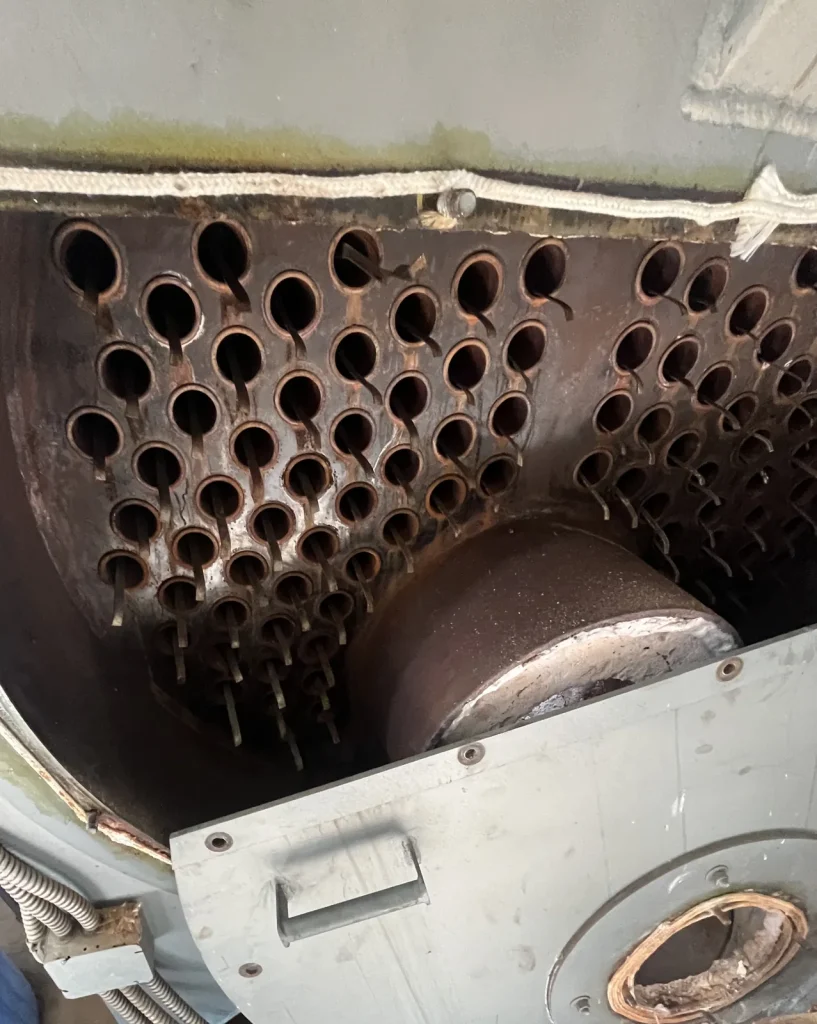


An industrial boiler installation in Los Angeles covers more than setting a boiler: the boiler has to be sized to the load, fit the room, connect to gas, water, steam, and the stack, meet South Coast AQMD emissions limits, and pass Cal/OSHA inspection before it carries the plant. McKenna Boiler Works, Inc. designs, builds, and installs turnkey industrial boiler systems, built in California, and serves Los Angeles. This post walks through each stage so a plant engineer knows what to plan for and in what order.

How is the boiler sized and selected?
Start with measured load. The old boiler’s nameplate shows what was installed, which can be more than the plant uses. Gas meter data from the existing boiler, converted to heat input, shows the real peak and minimum; steam flow meters do the same where fitted. One boiler horsepower is 33,475 Btu/hr, or 34.5 lb/hr of steam from and at 212°F. Then settle the pressure class. Steam at 15 psig or less and hot water at 160 psig or less and 250°F or less fall under ASME Section IV; anything above is a power boiler under ASME Section I, with annual Cal/OSHA inspection and a permit to operate.
Plants with load swings or no tolerance for downtime often do better with two boilers than one large one: either can be serviced while the other runs, and a smaller boiler at light load cycles less.
Will the boiler fit the room?
Older plants often have boiler rooms built decades ago around a boiler that is now being replaced. Check the footprint, the ceiling height, the door or wall opening the boiler must pass through, the rigging path from the street, and floor loading. A firetube boiler also needs clear space at one end to pull and replace tubes. McKenna builds standard models or custom-designs boilers to the customer’s specifications and to fit a specific room or footprint, which can avoid cutting walls or relocating the boiler room.
What does the installation include?
| System | What has to be right |
|---|---|
| Gas supply and fuel train | Supply pressure and capacity at full fire, regulator and meter size, vent lines from regulators and switches |
| Burner and controls | Burner matched to the boiler and the emissions limit; new McKenna boilers come with Autoflame controls as a standard option |
| Stack or vent | Sized for the boiler and burner, with clearances and termination as the manufacturer and local codes require |
| Feedwater system | Tank, pumps, and makeup water sized for the boiler, with condensate return |
| Blowdown tank or separator | Cools blowdown before it reaches the drain, as plumbing and sewer rules require |
| Steam or hot water piping | Stop valves, non-return valve where required, safety valve discharge piped to a safe location |
| Electrical | Power for the burner, pumps, and controls; interlocks wired as the burner management system requires |
| Water treatment | Your water treatment company sets the program, chemical feed, and test limits before the first fill |
Which permits apply in Los Angeles?
South Coast AQMD. The district covers all of Orange County, the non-desert parts of Los Angeles, Riverside, and San Bernardino Counties, and the Coachella Valley. Rule 1146 applies to boilers of 5 million Btu per hour heat input and larger, Rule 1146.1 to units above 2 and below 5 million Btu per hour, and Rule 1146.2 to smaller units. Larger units generally need a permit to construct before installation and a permit to operate; smaller units may be covered through equipment certification instead. The permit may also require a source test after startup. See AQMD source testing.
Cal/OSHA. Under the Boiler and Fired Pressure Vessel Safety Orders (Title 8), a power boiler is inspected and issued a permit to operate before it goes into regular service, and inspected internally and externally at least once a year after that under Labor Code 7682. Low-pressure boilers are exempt from the annual inspection and permit under 8 CCR 771 if their required controls are fitted and maintained.
Local building and fire approvals. The City of Los Angeles or the city or county where the plant sits issues mechanical, plumbing, and electrical permits for the installation. Check early, because plan review can set the schedule.
What happens at startup and commissioning?
Commissioning proves the boiler is safe and tuned before it carries the plant. It includes a boil-out or cleaning as the manufacturer specifies, testing every safety control (low water cutoffs, flame safeguard, limits, fuel valve proving, air and gas pressure switches), checking safety valve set pressures against the boiler’s maximum allowable working pressure and the system, and tuning combustion across the firing range to the AQMD limit with an analyzer. Operators are walked through normal operation, daily checks, and emergency shutdown. McKenna does the startup and commissioning on the boilers it installs.
What to do: installation planning checklist
- Gather 12 months of gas meter or steam flow data to size the boiler.
- Confirm the pressure or temperature every user needs.
- Measure the room, door or wall opening, rigging path, ceiling, and tube-pull clearance.
- Check gas supply pressure and capacity with the gas utility if the load is changing.
- Identify the AQMD rule for the boiler’s size and plan for the permit and any required source test.
- Plan local mechanical, plumbing, and electrical permits.
- Line up your water treatment company before the first fill.
- If the plant cannot be without steam or heat during the changeover, plan a rental boiler.
- Before startup, confirm that operators are trained, that lockout/tagout procedures cover the new boiler, and that nobody bypasses a safety control during commissioning. If a low water cutoff or flame safeguard does not trip during testing, shut the burner off manually and correct it before the boiler goes on line.
Common questions
How long does an industrial boiler installation take?
It depends on whether the boiler is a standard model or custom-designed, the permits involved, and the site work. Permitting and plan review can take as long as the build. Starting AQMD and building permits early keeps the schedule moving.
Does a new boiler in Los Angeles need an AQMD permit?
Larger boilers generally need a South Coast AQMD permit to construct and a permit to operate, and must meet Rule 1146 or 1146.1 limits for their size. Smaller units under Rule 1146.2 may be covered through equipment certification. Check the rule for the boiler’s heat input.
Can a new boiler be built to fit our existing boiler room?
Yes. McKenna builds standard models or custom-designs boilers to the customer’s specifications and to fit a specific room or footprint. Measure the rigging path and tube-pull clearance first.
Does McKenna install boilers outside Los Angeles?
Yes. McKenna serves Los Angeles and all of California, and does startup and initial commissioning in any state.
Who tunes the boiler after installation?
McKenna does the startup, commissioning, and combustion tuning on the boilers it installs, setting fuel and air across the firing range to meet the AQMD limit. After that, combustion should be checked at least once a year.
Planning an installation
To plan a turnkey boiler installation, call McKenna at (323) 987-1816.